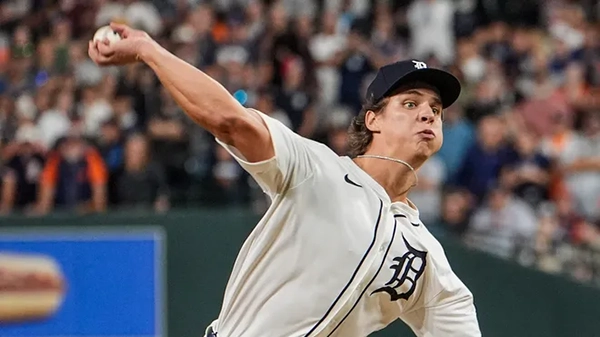
Pittsburgh at -109 and Detroit at -110 tells you the market sees no difference between these two starters — but Bubba Chandler’s 76 walks in 151.1 innings versus Jackson Jobe’s 14 walks in 40.2 innings is a structural gap the price is treating as noise. A near-identical moneyline dressed over a real command mismatch warrants a closer look at what the number is actually reflecting.
Bubba Chandler vs Jackson Jobe: Pittsburgh Pirates at Detroit Tigers Betting Preview
The market has essentially flipped a coin here, posting Pittsburgh at -109 and Detroit at -110 — barely a rounding error between them. On the surface, that makes sense: both clubs are out of playoff contention, both offenses are middling, and Comerica Park plays nearly neutral at a 0.99 park factor. Nothing screams edge.
But the coin-flip framing ignores the most important variable in any MLB game: the quality of the starting pitcher. Jackson Jobe enters with a 3.98 ERA, a 1.20 WHIP, and a BB/9 of 3.10 across 40.2 innings. Bubba Chandler counters with a 4.34 ERA, a 1.37 WHIP, and a BB/9 of 4.52 across 151.1 innings. That isn’t a coin flip — it’s a meaningful control gap dressed up as one. At -110 for the home side, you don’t need a large margin to find value. You just need to trust the pitching differential the price is ignoring.
Game Info & Betting Lines
- Date/Time: Friday, September 25, 2026 | 6:40 PM ET
- Venue: Comerica Park (Park Factor: 0.99 — neutral run environment)
- TV: MLB.TV, Tigers.TV
- Probable Starters: Bubba Chandler (PIT) vs Jackson Jobe (DET)
- Moneyline: Pittsburgh Pirates -109 / Detroit Tigers -110
- Run Line: Detroit Tigers +1.5 (-193) / Pittsburgh Pirates -1.5 (+158)
- Total: 8.0 (Over -102 / Under -118)
Why This Number Is Off
The market’s logic is defensible: this is a late-September game between two teams going nowhere, with thin rosters and abbreviated motivation. Pittsburgh is riding a 7-3 last-10 stretch and clinched its first non-losing season in eight years Thursday night. Detroit has lost six of eight. Oddsmakers may be weighting the Pirates’ momentum and slightly better offensive numbers — a .735 OPS against Detroit’s .720 — to wash out the pitching differential.
But the concern is that momentum narratives in meaningless final series are notoriously unstable. Pittsburgh’s emotional high from clinching non-losing status Thursday could just as easily produce a flat effort Friday with nothing left to chase. Detroit, playing at home with a young arm they presumably want to showcase, is a reasonable lean even without a sharp identity.
Where the line gets it wrong: it treats Chandler’s large-sample command issues as neutral context rather than a signal. His 76 walks in 151.1 innings aren’t noise — they’re a structural flaw that creates base traffic, elevates pitch counts, and invites bullpen exposure earlier than ideal. Jobe’s 14 walks in 40.2 innings paint the opposite picture. In a game projected to be decided by less than a run, free passes matter more than batting average differentials.
What Separates the Pitching
The head-to-head isn’t close when you look past the ERA gap. Chandler’s arsenal is built around a 98.3 mph four-seamer that he deploys nearly half the time (48.9% usage), but that pitch generates only a 19.8% whiff rate and an xwOBA-against of .331 — usable but not dominant. His best weapon may actually be his sweeper, which produces a .204 xwOBA and 28.6% whiff rate, though he deploys it just 3.9% of the time. The mismatch: he leans heavily on a fastball that doesn’t miss bats at an elite rate, then pads his walk totals when hitters sit on it and force him into deep counts.
Jobe’s profile flips that script. His slider is his highest-usage secondary pitch at 25.0% deployment, posting a .286 xwOBA and 25.3% whiff rate. His sinker (18.4% usage, .248 xwOBA) serves as a ground-ball-inducing complement that keeps the ball in the yard and limits hard contact on the ground. When he needs a swing-and-miss, he reaches for his curveball — a .159 xwOBA with a 33.3% whiff rate and a 30.0% put-away rate — which is his sharpest pure bat-misser even if it’s used more selectively at 9.6% of the time. His changeup adds another layer at 30.0% whiff and .273 xwOBA. His four-seamer is his biggest vulnerability, posting a .440 xwOBA against, which explains his elevated HR rate (7 HR in 40.2 IP). But the overall shape of his arsenal creates swing-and-miss outcomes that Chandler’s does not, and his K/9 of 9.52 versus Chandler’s 8.21 reflects that difference.
The lineup matchup amplifies the gap. Pittsburgh’s top threats — Oneil Cruz (.496 xwOBA, 32.4% hard-hit rate) and Brandon Lowe (34 HR) — present genuine power against Jobe’s vulnerable fastball. Detroit’s lineup is quieter top-to-bottom, but Riley Greene (.469 xwOBA) and Dillon Dingler (.410 xwOBA, confirmed in the lineup at #5) can hurt a pitcher who issues free passes. Chandler’s 4.52 BB/9 is an open invitation to the Greene-Dingler tier of the order to sit and wait.
The Pushback
The honest version of this bet acknowledges how thin the edge is, and Jobe’s small sample is the first place to start. 40.2 innings is not a large enough body of work to fully trust a 3.98 ERA or a 1.20 WHIP. His HR rate of approximately 1.55 per nine innings is a real exposure flag — Comerica Park is nearly neutral, not a suppressor, and Cruz and Lowe can do damage on a flat fastball left over the middle.
Pittsburgh’s offense is also marginally better than Detroit’s across the board: .253 batting average versus .241, .331 OBP versus .320, .404 SLG versus .400. Those aren’t massive gaps, but in a tight projected game, marginal advantages compound. The Pirates have gone 7-3 over their last 10 and carry real offensive momentum behind Cruz, Lowe, and Bryan Reynolds.
Detroit’s bullpen is also genuinely depleted. The Tigers are missing Burch Smith, Will Vest, and Troy Melton to IL stints, among others — that’s real depth gone from a relief corps that was already stretched thin. If Jobe can’t give them six-plus innings, the bridge to a close could get ugly in a hurry.
Run Environment Check
The total is set at 8.0 with the over priced at -102 and the under at -118. Comerica plays nearly neutral at 0.99 park factor, so the suppression argument is minimal. The numbers project a combined 9.1 runs, which would suggest over value — but those projections assume both offenses perform close to their season averages against average pitching. Jobe’s command profile and swing-and-miss depth likely suppresses Pittsburgh’s output below expectation, and the run line at -193 for Detroit +1.5 is too expensive to layer onto a lean-confidence play.
Joe Jensen’s Pick
The case here is simple: the market is pricing this like a coin flip, but Jobe’s command profile versus Chandler’s structural walk problem creates a real, if modest, pitching edge in Detroit’s favor. The BB/9 gap — 3.10 versus 4.52 — isn’t noise over 151.1 innings from Chandler. It’s a feature of who he is, and it will create opportunities for Detroit’s lineup even on a quieter offensive night.
I looked at the over here, but I’m not confident enough in both starters’ leakiness to push through a bet at -102. Jobe’s command and swing-and-miss profile should suppress Pittsburgh’s scoring below the season-average assumptions baked into the total, and while Chandler’s walk rate adds legitimate over risk, the jury’s still out on how Jobe’s home run exposure plays in a neutral park on any given night. That’s not enough conviction to lay juice on the over when one of the two starters actively works against it. The under at -118 is too expensive for a team I think can score. So the total sits. The play is the Detroit Tigers moneyline (-110) for 1 unit — a lean, not a hammer, on the pitching edge the market isn’t pricing.
Bet: Detroit Tigers Moneyline (-110) — 1 Unit