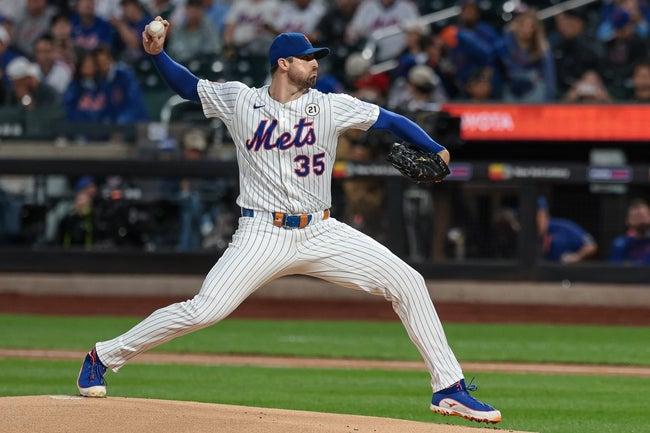
Clay Holmes carries a 2.86 ERA and a sinker-heavy arsenal tailor-made to neutralize a Cardinals offense posting a .695 team OPS — yet the total sits at 8.0, a number that leans almost entirely on Matthew Liberatore being hittable and gives Holmes’ run-prevention profile almost nothing. The pitching profiles here are pulling in opposite directions, and the market is splitting the difference rather than accounting for the gap.
Matthew Liberatore vs. Clay Holmes: St. Louis Cardinals at Chicago Cubs Betting Preview
The obvious narrative heading into Wrigley Field on Friday afternoon is the Cubs’ impressive 71-51 record and a rotation that, today at least, features a legitimate ace-caliber performance from Clay Holmes. The Cardinals counter with Matthew Liberatore, a pitcher with a 5.15 ERA and 1.52 WHIP who has been one of the more hittable starters in the National League. The market has set the total at 8.0, which feels like it’s splitting the difference between two very different arms.
The pitching gap here is real and significant. Holmes’ ability to suppress a Cardinals offense that carries a .695 team OPS — well below league average — is the central edge this game offers bettors. Wrigley Field registers a park factor of 1.02, essentially neutral, so the venue isn’t distorting anything. The question is whether Holmes’ dominance offsets Liberatore’s blowup risk enough to keep the combined total under 8.
The Cubs arrive from Washington having dropped a 7-0 shellacking Thursday after winning two prior, while St. Louis comes in riding momentum from a series win over the Phillies. Neither recent result drives the handicapping here — the pitching matchup does.
Game Info & Betting Lines
- Date/Time: Friday, August 14, 2026 | 2:20 PM ET
- Venue: Wrigley Field | Park Factor: 1.02 (neutral)
- TV: Apple TV
- Probable Starters: Matthew Liberatore (STL) vs. Clay Holmes (CHC)
- Moneyline: Cardinals +169 / Cubs -182
- Run Line: Cubs -1.5 (+118) / Cardinals +1.5 (-142)
- Total: 8.0 (Over -109 / Under -110)
Why This Number Is Close
The market is doing something reasonable here. It’s acknowledging that Liberatore is a genuine blowup candidate — a pitcher who has allowed 20 home runs in 113.2 innings and who the Cubs’ lineup, averaging 5.2 runs per game on the season with 155 home runs, should be able to damage. Setting the total at 8.0 reflects the legitimate possibility that Liberatore hands the Cubs four or five runs before the fifth inning ends.
Where the market is slightly miscalibrated is on the Cardinals’ side of the equation. Holmes’ 2.86 ERA and 1.16 WHIP in 56.2 innings represents genuine run prevention against a Cardinals offense that ranks among the weakest in the league. St. Louis posts a .316 OBP and .379 SLG — they don’t walk enough, they don’t slug enough, and their 933 strikeouts on the season tell you this is a lineup that expands zones and generates weak contact. Holmes’ sinker-heavy approach is almost perfectly designed to exploit those tendencies.
The total of 8.0 leans on Liberatore being bad. Holmes being good is the counterweight that keeps this game from going over, and I think the market is underweighting how thoroughly he can neutralize the Cardinals’ offensive ceiling.
What Separates the Pitching
The gap between these two arms is about as wide as you’ll find in a regular-season game. Holmes operates primarily off a 48.7% sinker at 93.7 mph that generates soft contact rather than swings and misses — his sweeper (20.3% usage) holds opposing hitters to an xwOBA of .192 with a 26.2% whiff rate, and his curveball posts an xwOBA of .194. Combined, these secondary offerings give Holmes a legitimate put-away arsenal that complements his ground-ball-inducing fastball. He has allowed just 4 home runs in 56.2 innings — a rate of 0.64 HR/9 — which is precisely the profile that keeps multi-run innings off the board against a Cardinals team that relies on stringing contact rather than launching the ball.
Looking at the Cardinals’ top hitters against Holmes: Jordan Walker carries a 25.5% strikeout rate and a 29.1% whiff rate, and he’s 1-for-8 in 9 PA in prior looks against Holmes with 3 strikeouts. His xwOBA of .443 is actually the higher of the Cardinals’ two dangerous bats — but that raw number is misleading here. Walker’s whiff profile makes him a favorable matchup for a sinker-heavy pitcher who doesn’t need to miss bats, just induce weak contact and soft ground balls. Alec Burleson (.432 xwOBA) is the more legitimate concern — his 11-PA sample (4-for-10) shows he’s made real contact against Holmes before, and he’s the one Cardinal I’d watch in this lineup.
Liberatore, by contrast, leans on a slider (36.4% whiff rate, .265 xwOBA) and curveball (35.8% whiff rate, .252 xwOBA) as his best weapons, but his four-seamer gets hammered — .394 xwOBA against — and his 94.4 mph average velocity on it doesn’t miss enough bats at 11.6% whiff rate. Pete Crow-Armstrong has seen Liberatore 18 times in his career, hitting .286 with a .452 xwOBA. Ian Happ carries a .415 xwOBA against right-handed pitching, but before you overweight that split, his BvP against Liberatore tells a different story: in 17 plate appearances, Happ is hitting just .083 with 5 strikeouts. That’s not a sample size to dismiss — it suggests something about how Liberatore’s stuff plays against Happ specifically, even if the raw platoon split screams danger. The Cubs have the lineup construction to do real damage against Liberatore’s fastball-heavy approach, but the Happ number is a genuine wrinkle worth noting.
The Pushback
The honest version of this pick requires engaging with a few real objections. First, Liberatore’s blowup risk is not hypothetical — a 5.15 ERA over 113.2 innings means he’s been gettable all season, and the Cubs’ offense (.757 OPS, 155 HR) is among the better units he’ll face. If Liberatore implodes before the fifth inning and hands Chicago five or six runs, the under is in trouble before Holmes even takes the mound.
Second, the Cubs’ bullpen depth is compromised. Porter Hodge, Ben Brown, Riley Martin, Hunter Harvey, Daniel Palencia, Hoby Milner, and Phil Maton are all on the IL. That’s a taxed relief corps that could surrender late runs if the game stays within reach. The Cardinals, coming off a series win over the Phillies and showing some offensive life (Burleson drove in five runs in that series), could punish a depleted pen if given enough innings.
Third, Wrigley Field in August isn’t irrelevant. A neutral park factor of 1.02 sounds benign, but wind blowing out can change the calculus quickly. If conditions favor hitters today, Liberatore’s home run rate (1.59 HR/9) becomes even more alarming.
These objections are real. None of them change my position — but they’re why this isn’t a three-unit bet.
Bets I’m Passing On
Cubs Moneyline (-182): The Cubs are probably going to win this game. Holmes is the better pitcher, the Cubs are 20 games over .500, and the Cardinals’ offense doesn’t scare anyone. But -182 asks you to risk $182 to win $100 on a team that wins maybe 68% of the time in this spot. The juice ceiling is simply too high for the return, even when the side is correct.
Cardinals Moneyline (+169): Liberatore’s 5.15 ERA against a Cubs offense that’s been one of the hotter units in the NL over the past month makes Cardinals ML a gamble, not a value play. The pitching gap is too wide to fade Holmes here.
Run Environment & Game Shape
The numbers I’m working off of — Cubs 4.9, Cardinals 4.5 — technically clear the total of 8.0 at 9.4 projected runs. That’s the honest tension in this pick, and I’m not going to pretend it isn’t there. The raw projection says over. So why am I on the under?
Because those projections are built on season-long averages, and season-long averages include every Matthew Liberatore start, not just this one. They include the nights he got through six innings and the nights he didn’t make it out of the third. They include Cardinals games against Zack Wheeler and games against back-end arms. The aggregated number smooths over the matchup-specific information that actually matters today.
What matters today is that Clay Holmes — a pitcher with a .192 xwOBA allowed on his sweeper and a sinker that generates soft contact at nearly half his usage — is facing a Cardinals lineup with a .695 team OPS, 933 strikeouts, and a .316 OBP. That lineup does not punish elite sinker-heavy pitchers. It expands zones, makes weak contact, and generates the kind of groundball outs that Holmes lives on. Even if Liberatore gives the Cubs four or five runs before the fifth, Holmes shutting down St. Louis to two or three keeps the combined total in range.
The park factor at 1.02 is neutral enough that it doesn’t distort the run environment enough to change the calculus. What matters is that Holmes’ run-suppression profile against this specific Cardinals offense is the strongest matchup advantage on the board today — and at -110, you’re not paying a premium to access it.
The Pick
The case for the under isn’t that Liberatore will be good — he probably won’t be. It’s that Holmes will be good enough, and the Cardinals’ .695 OPS lineup will be limited enough, that the St. Louis side of this total stays contained. Holmes’ sinker-heavy arsenal was built to neutralize exactly the kind of contact-dependent, low-walk, high-strikeout offense St. Louis brings to the plate. Even in a game where Liberatore gives up three or four early, Holmes holding the Cardinals to two or three keeps the combined number under 8.
At -110, that’s a number worth backing with two units and moderate confidence.
Bet: Under 8.0 — 2 Units — Moderate Confidence