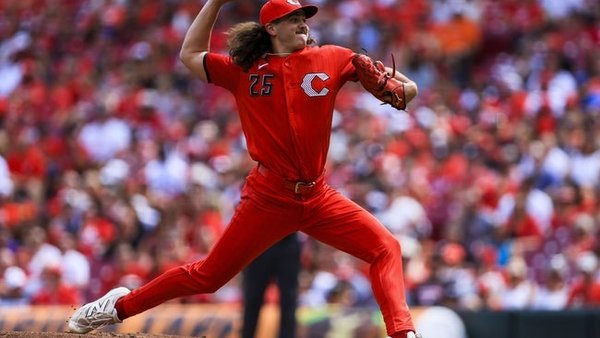
Great American Ball Park’s 1.10 run factor is already a problem — pair it with David Peterson’s 5.11 ERA and Rhett Lowder’s 5.79 ERA and 18 home runs allowed in 124.1 innings, and the under juice at -116 is doing more work than the pitching profiles can support. The number is close, but the structural weight of both starters tilts the same direction.
David Peterson vs. Rhett Lowder: Chicago Cubs at Cincinnati Reds Betting Preview
The Cubs took yesterday’s game 5-2 behind a clean outing from Matthew Boyd, but Saturday’s result masks the real story heading into Sunday’s finale: the pitching matchup drops significantly. Boyd outperformed his recent form; today you get David Peterson (8-8, 5.11 ERA) against Rhett Lowder (6-11, 5.79 ERA, 1.52 WHIP) — two arms that have given up runs consistently all season. That combination, set inside a park carrying a 1.10 run factor, creates a specific kind of game the total at 10.0 may not fully account for.
The market is pricing this with juice on the under at -116, meaning books expect the suppression side to attract more liability. That’s the tension worth examining. The numbers project 10.6 combined — a modest but real lean toward the over. The question isn’t whether this game blows up; it’s whether the structural conditions are aligned enough to back the number.
Game Info & Betting Lines
- Date/Time: Sunday, September 20, 2026 | 1:40 PM ET
- Venue: Great American Ball Park (Park Factor: 1.10 — hitter-friendly)
- Probable Starters: David Peterson (LHP, CHC) vs. Rhett Lowder (RHP, CIN)
- Moneyline: Cubs -155 / Reds +128
- Run Line: Cubs -1.5 (+104) / Reds +1.5 (-125)
- Total: 10.0 (Over -104 / Under -116)
Why This Number Is Close — But Slightly Off
The market set this total at 10.0 for a reason. Saturday’s game produced only 7 runs in this same park with these same teams — proof that even a hitter-friendly environment doesn’t guarantee fireworks every night. The under juice at -116 suggests books have seen enough action on the low side to shade the price. That’s the legitimate case for staying off the over.
But here’s the problem with the suppression argument: Saturday’s pitching featured Boyd limiting Cincinnati to 2 runs across a tighter outing than his season line suggested. Today’s arms don’t offer the same floor. Peterson’s 5.11 ERA isn’t built on bad luck — he’s been a consistent run-allowance risk all season. Lowder’s 5.79 ERA with 18 home runs allowed in just 124.1 innings is a liability at any park, let alone one running a 1.10 run factor.
Where the market may be slightly wrong: the under juice implies a probability north of 53% for a sub-10 finish. Against these two starters, in this park, with the Cubs owning a .771 team OPS and MLB-leading 214 home runs, that implied probability feels generous to the pitchers. The 0.6-run gap between the projection (10.6) and the posted total (10.0) isn’t massive, but the structural weight of both starters’ profiles tilts consistently toward the over side.
What Separates the Pitching
This isn’t a good-versus-bad pitching matchup — it’s bad versus worse, and the gap matters for the total.
Lowder is the bigger vulnerability. His sinker sits at 93.1 mph and generates a concerning xwOBA of .399 against, which means hitters are making quality contact even on his primary pitch. His slider (26.3% usage, 85.1 mph) does create swing-and-miss — 31.3% whiff rate — but his curveball is a problem: .545 xwOBA against, the kind of number that gets punished when location slips. In 124.1 innings, his 18 home runs allowed translates to a rate that turns into catastrophe against a Cubs lineup where Pete Crow-Armstrong (xwOBA .472, 44 HR) and Alex Bregman (26 HR) sit at the top of the order. Crow-Armstrong’s splits against right-handed pitching show an elevated xwOBA of .501 — a real mismatch against Lowder’s arsenal, even accounting for a small 7-PA BvP sample.
Peterson is the relatively steadier arm — but not by enough to anchor an under. His 5.11 ERA reflects a season-long pattern of run allowance, not an outlier stretch. The Reds’ lineup ranks near the bottom of the NL in runs scored (641) and carries a .229 team average, but Elly De La Cruz at .490 xwOBA with a 9.5% barrel rate and Sal Stewart at .412 xwOBA with 32 home runs are genuine dangers against a left-hander. De La Cruz’s splits don’t drop sharply against lefties — his vsLHP xwOBA sits at .485, nearly identical to his overall number — meaning Peterson gets no easy outs at the top of Cincinnati’s lineup.
The key distinction: Peterson limits blowup risk more than Lowder does, but neither starter projects for the kind of efficient, low-traffic innings the under requires. Both are 5-6 inning pitchers at best, which means back-end relievers — carrying significant workload strain — will face meaningful lineup exposure.
The Pushback
The case against this over is real, and it deserves more than a dismissal.
Start with the recent form. Cincinnati is 3-7 over their last 10 games and ranks near the bottom of the NL in runs scored (641) and batting average (.229) — a pattern that’s hard to ignore entirely, even accounting for sample noise. Saturday’s game ended 5-2, not 8-6. The run environment can be suppressed even when conditions favor scoring, and yesterday is direct evidence of that.
Then there’s the market signal. When the under carries juice at -116, sharp money has likely tested the line and found value on the low side. Books don’t shade prices arbitrarily. The Saturday result — both teams, same park, same series — landed well under 10. That’s not noise you can wave away.
Peterson also has a real argument against this Reds lineup. Cincinnati’s offense is built around a handful of dangerous hitters surrounded by legitimate outs. JJ Bleday (.214 AVG, .733 OPS) and Eugenio Suárez (.209 AVG, .728 OPS) are real strikeout risks — Suárez whiffs on 33.7% of pitches — and a lefty with Peterson’s profile can navigate that middle-of-the-order weakness if he pitches to his slider and avoids the heart of the zone against De La Cruz and Stewart. The Reds’ lineup gives Peterson a path to a functional 5-inning outing, which could be enough to keep the under alive if the Cubs’ bullpen — depleted as it is — manages the back half cleanly.
The Cubs’ bullpen situation cuts both ways. Six relievers on the IL is a legitimate structural concern: Porter Hodge, Ben Brown, Riley Martin, Hunter Harvey, Phil Maton, and Gavin Hollowell are all unavailable. That’s depth erosion that matters in a game where the starter is projected to exit early. But it’s worth noting that bullpen depletion can also mean lower-leverage arms facing hitters cold, which doesn’t automatically translate to runs — it increases variance more than it guarantees production.
Joe Jensen’s Pick
Two ERA 5+ starters, a 1.10 park factor, and a numbers-based projection of 10.6 runs against a posted total of 10.0 — the structural case for the over is clear enough to act on at -104. I’m not chasing a blowup here; I’m backing the math on two vulnerable arms in a hitter-friendly environment where the price is still reasonable. Take the Total Over 10.0 at -104, 2 units, moderate confidence.