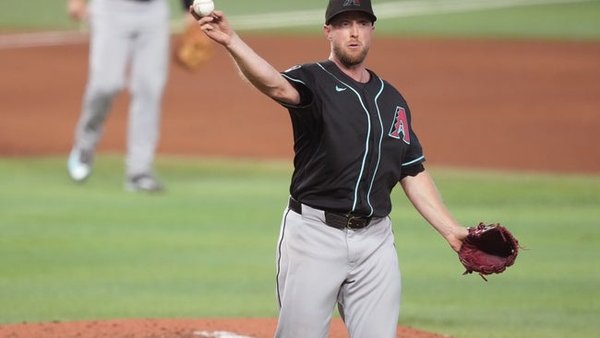
Cristian Javier has posted a 6.23 ERA and nine walks in just 13 innings this season — numbers that paint a pitcher in serious command trouble. Merrill Kelly’s 3.49 ERA and 1.14 WHIP tell the opposite story, yet the moneyline has Arizona sitting at plus money, treating this like a near-even game the pitching profiles don’t support.
Merrill Kelly vs. Cristian Javier: Arizona Diamondbacks at Houston Astros Betting Preview
The headline here isn’t Arizona’s wildcard position or Houston’s home advantage. It’s a starter gap that the moneyline price hasn’t fully priced in. Merrill Kelly carries a 3.49 ERA and 1.14 WHIP over 111 innings this season — a legitimate mid-rotation anchor who has been one of the more consistent arms in the NL. On the other side, Cristian Javier has posted a 6.23 ERA, 1.54 WHIP, and nine walks in just 13 innings of work. That is not a minor discrepancy. That is a significant, quantifiable mismatch the market is softening with home-field credit and recent Houston momentum.
One note on Kelly’s ERA: ESPN surfaces a 5.08 figure that appears to reflect a partial-season or legacy data window. The full-season line — 3.49 ERA, 1.14 WHIP, 111 IP — is the number that matters. The market may be partially anchoring to the wrong figure, and if so, that’s part of why Arizona is sitting at plus money despite numbers that favor them to win 4.8–4.5.
Arizona arrives from a series against Philadelphia where they salvaged a 1-0 closer on the back of seven relievers. Houston is coming off a 6-2 win over Chicago that pushed their AL West lead to 2.5 games. Both teams have something to play for — but tonight, the starting pitcher edge points clearly in one direction.
Game Info & Betting Lines
- Date/Time: Friday, September 4, 2026 — 8:10 PM ET
- Venue: Daikin Park (Minute Maid Park) | Dome | Park Factor: 0.96 (slight pitcher’s lean)
- Probable Starters: Merrill Kelly (ARI) vs. Cristian Javier (HOU)
- Moneyline: Arizona Diamondbacks +112 / Houston Astros -135
- Run Line: Arizona Diamondbacks +1.5 (-188) / Houston Astros -1.5 (+155)
- Total: 9.0 (Over +100 / Under -120)
Why This Number Is Off
The market is balancing a few real factors to land at Houston -135. Houston is at home, playing with AL West separation on the line and off three wins in their last four games. Their offense — anchored by Yordan Alvarez’s .316/.420/.615 slash and 37 home runs — is genuinely dangerous. The books are right to give Houston respect. This isn’t a line set by accident.
But here’s where I think the market is slightly wrong: it’s over-crediting Houston’s home advantage and under-penalizing Javier’s command collapse. Nine walks in 13 innings is alarming in any context — a rate that doesn’t just reflect bad luck or one meltdown. It signals a pitcher who cannot reliably throw strikes. Arizona’s lineup, which carries genuine patient hitters and legitimate power threats, is built to punish exactly that kind of volatility.
Meanwhile, the numbers give Arizona a 59.3% win probability — implying a fair moneyline closer to -145. Getting the same side at +112 represents a meaningful gap. The market is treating this as a near-coin-flip when the underlying data says Arizona should be a modest favorite. That’s the edge. It’s not a hammer spot, but the number is demonstrably off.
What Separates the Pitching
Kelly and Javier are not in the same tier tonight, and the Statcast data makes that concrete. Kelly works with a six-pitch arsenal led by a 93.1 mph four-seamer (24.9% usage, .300 xwOBA against) and a sweeper that is his true out pitch — 34.7% whiff rate, .194 xwOBA against, 24.8% put-away rate. That sweeper is a legitimate strikeout weapon, and his curveball (32.0% whiff, .304 xwOBA) gives him a second breaking ball option. He’s not a high-strikeout arm — his 5.92 K/9 is modest — but he generates soft contact, limits walks (27 on the season), and allows hitters to beat themselves. Houston’s Yordan Alvarez sits at a terrifying .520 xwOBA overall and .535 against right-handers, which makes him the single biggest threat to Kelly’s night. Alvarez has gone deep once in 3 career plate appearances against Kelly. That at-bat is circled in red every time it comes around.
Javier’s profile is the opposite story. His four-seam fastball — thrown 23.1% of the time at 93.7 mph — holds a .523 xwOBA against, one of the more alarming contact-quality numbers you’ll find. His cutter (.536 xwOBA against) is even worse. The one pitch that works is his sweeper (.174 xwOBA, 42.1% whiff), but it accounts for only 16.5% of his usage. That leaves him leaning on a sinker that generates some whiffs (22.0%) but a .350 xwOBA against, and a changeup that has been taken deep — .762 xwOBA against in the limited sample. The command issues compound all of this: when a pitcher who can’t reliably throw strikes also gives up hard contact on his primary offerings, the innings get ugly fast. Corbin Carroll (.390 xwOBA, .394 vs. right-handers) and Gabriel Moreno (.384 xwOBA, .366 vs. right-handers) are both capable of punishing Javier’s walks-into-counts pattern. The gap between these two starters is real and measurable.
The Pushback
The honest concern starts with sample size. Javier has thrown just 13 innings this season. It’s possible one or two implosion outings are distorting the ERA, and that the walks reflect rustiness rather than a structural command breakdown. A pitcher returning from a rough stretch can right the ship quickly — and if Javier finds the zone early tonight, Houston’s offense is more than capable of carrying the game. Alvarez alone is a one-man wrecking crew against right-handed pitching, and Kelly does have a .535 xwOBA allowed to right-handed hitters in his career sample against Alvarez specifically. One mistake pitch doesn’t need context — it just needs to land in the seats.
Arizona’s RISP drought through the Philadelphia series is also worth noting. They went hitless with runners in scoring position across the entire three-game series, and while they salvaged the finale 1-0 on a solo shot, strand-rate variance can bite hard in one-run games. If Javier battles through walks but Arizona can’t cash them in, the value edge evaporates. Add in the fact that Arizona used seven relievers Wednesday and the bullpen depth behind Kelly carries some question marks heading into a night game on a short rest schedule.
These are real concerns. I’m not dismissing them. But they’re also the kind of risks that are already reflected in a +112 price — which is precisely why this spot exists.
Rejected Angles
The run line doesn’t work at -188 for Arizona +1.5. Paying -188 on a +112 team to cover 1.5 runs is a structural disaster — you’re laying heavy juice on a cover that requires Arizona to win by two or more, or you’re giving up the value entirely. Pass.
The total at 9.0 is similarly uninteresting. The over is priced at +100, which sounds attractive, but Javier’s volatility cuts both ways — if he’s getting hurt, he exits early and Houston’s bullpen comes in to stabilize. Kelly’s profile points toward a lower-scoring game on Arizona’s half of the ledger. I’d expect something in the 8–10 run range, which is right where the number sits. No conviction either direction at those prices.
Run Environment & Game Shape
Daikin Park plays as a mild pitcher’s park at 0.96 run factor, and the dome eliminates weather as a variable. The total of 9.0 reflects a legitimate offensive environment from both clubs — Houston’s .723 OPS and 185 home runs are real, and Arizona contributes enough punch to keep the number honest. But the shape of this game is more likely to be determined by Javier’s command than by raw offensive output. If he walks three batters in the first two innings and Arizona converts, this could look like a 5–3 or 6–4 final. If he somehow finds the zone and pitches into the fifth or sixth with his sweeper working, the total stays suppressed and Kelly matches him pitch for pitch.
That’s exactly why neither the over nor the under is a confident play tonight. Javier’s volatility makes the over a real possibility — but Kelly’s contact suppression and the park’s slight lean keep the ceiling in check. The total sits right at the inflection point where the game could go either way depending on Javier’s first two innings. Betting the total means picking which version of Javier shows up, and that’s a coin flip I’m not interested in. The moneyline, on the other hand, captures the value regardless of exact run totals — Arizona winning 3–2 cashes just as well as Arizona winning 7–4.
The Pick
Arizona Diamondbacks moneyline, +112. Two units. Moderate confidence.
The thesis is straightforward: Kelly is one of the more reliable mid-rotation starters in the NL right now, Javier has been genuinely bad in limited work this year, and the market hasn’t fully penalized that gap. A 59.3% win probability implies Arizona should be priced somewhere around -145. Getting them at +112 is a 16-plus percent implied probability advantage — that’s not a marginal edge, that’s a real one.
I understand the counterarguments. Alvarez is terrifying, the bullpen is stretched, and Arizona’s RISP numbers have been ugly lately. None of that disappears just because I like the price. But +112 already bakes in some of that uncertainty. The books didn’t set this line by accident — they’re giving Houston credit for the home field, the momentum, and the Alvarez factor. I’m simply saying they’ve gone a step too far, and the starter gap justifies backing Arizona at plus money.
This isn’t a max play. It’s a two-unit spot where the data tilts clearly in one direction and the price gives you room to be wrong. I’m on the Diamondbacks. Lock it in.