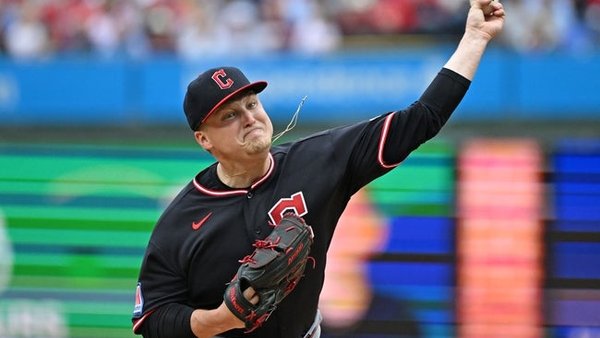
Parker Messick’s 2.55 ERA and .202 xwOBA changeup walk into a matchup against a Kansas City starter whose two most-used pitches are both sitting in mediocre-to-bad contact quality territory. The total is posted at 8.5 in a park with a 0.95 run-suppressing factor — and the back-to-back blowouts that inflated this number were bullpen disasters, not a preview of today’s pitching conditions.
Parker Messick vs. Daniel Lynch IV: Cleveland Guardians at Kansas City Royals Betting Preview
Cleveland clinched the AL Central on Saturday night, winning 11-5 in a game that felt comfortable by the third inning. Now the Guardians roll out Parker Messick — their most dependable arm all season — against a Kansas City club that’s 68-93 and limping toward a finish line they’d rather forget. The pitching gap here is real and significant. The problem is that everyone knows it, and the market has priced Cleveland accordingly at -151. That number exceeds my hard juice ceiling of -130, which means the moneyline is off the table regardless of how much I trust Messick.
The cleanest expression of Cleveland’s advantage isn’t the moneyline — it’s the total. The numbers project a combined 8.6 runs against a posted total of 8.5, and Kauffman Stadium’s park factor of 0.95 provides just enough environmental pressure to tip that projection Under. This isn’t a sledgehammer call. It’s a pitcher-driven lean in a run-suppressing environment, supported by one of the better starters in the American League.
Game Info & Betting Lines
- Date/Time: Sunday, September 27, 2026 | 3:10 PM ET
- Venue: Kauffman Stadium | Park Factor: 0.95 (run-suppressing)
- Probable Starters: Parker Messick (CLE) vs. Daniel Lynch IV (KC)
- Moneyline: Cleveland Guardians -151 / Kansas City Royals +125
- Run Line: Cleveland Guardians -1.5 (+112) / Kansas City Royals +1.5 (-135)
- Total: 8.5 (Over -110 / Under -110)
Why This Number Is Close
The market has set this total at 8.5 for defensible reasons. Kansas City’s lineup carries a .717 OPS — modest but not toothless — and the two previous games in this series produced scores of 12-9 and 11-5. Books aren’t ignoring that context. They’re pricing in the fact that KC’s power trio of Jac Caglianone (xwOBA .461), Bobby Witt Jr. (xwOBA .431), and Carter Jensen (27 HR, xwOBA .395) can generate a crooked inning against anybody. That’s a legitimate offensive threat, and the 8.5 number respects it.
The case for the Over is real: back-to-back high-scoring games, a depleted KC bullpen that could surrender a big frame if Messick exits before the seventh, and Cleveland’s own lineup capable of piling on if Lynch unravels early. I understand why a sharp bettor would look at this series and pound the Over.
But here’s where the market is slightly off: those two previous blowouts were both bullpen disasters, not starter-driven offensive explosions. Today features a starter in Messick whose numbers are categorically different from anyone Kansas City faced this weekend. The projected 8.6 combined runs sitting one tick above the total is technically an Over signal, but a 0.1-run margin is not a betting edge — it’s a coin flip. With the park factor applied, the lean shifts Under. The market priced the total at 8.5 accounting for the high recent scoring; it didn’t fully credit how different Messick is from the arms KC shelled the last two nights.
What Separates the Pitching
Parker Messick enters this start with a 2.55 ERA, 1.04 WHIP, and 183.1 innings pitched — that’s not a hot stretch, that’s a full-season body of work built on genuine suppression. His arsenal is designed to generate weak contact: a four-seam fastball sitting 94.3 mph at 41.1% usage that holds hitters to a .256 xwOBA, paired with a changeup at 23.3% usage that produces a 34.3% whiff rate and .202 xwOBA. That changeup is his strikeout weapon and his most important pitch against a Kansas City lineup that has real trouble with left-handed breaking action. He’s also added a cutter (5.1% usage, 31.2% put-away rate) that gives him a late-count option against right-handed hitters. The profile creates a lot of weak grounders and early counts — the kind of innings that keep pitch counts low and limit run crosstalk to the bullpen.
Daniel Lynch IV is operating in a different tier entirely. His 4.13 ERA and 6.02 K/9 over 80.2 innings tell the story of a starter who keeps the ball in the yard adequately (9 HR) but doesn’t miss bats. To understand why the Under makes sense against him, you have to look at his actual arsenal — and the picture isn’t pretty. His primary pitch is a sinker at 29.8% usage (94.0 mph, xwOBA .339) — a pitch that generates grounders in theory but is getting tagged for well above league-average contact quality this season. His second-most-used pitch is a changeup at 24.8% usage, posting a .338 xwOBA — similarly hittable. Together, those two pitches account for over half his usage and both are sitting in mediocre-to-bad xwOBA territory. His slider is genuinely good — 33.3% whiff rate and .228 xwOBA at 19.3% usage — but it’s his third option, not his anchor. And his four-seam fastball, while thrown only 17.2% of the time, is a secondary liability: a .414 xwOBA against with just a 14.0% whiff rate. So Lynch’s two most-used pitches are both mediocre, his best pitch is used less than a fifth of the time, and his secondary fastball is getting punished when it appears. Cleveland’s lineup isn’t a powerhouse (.696 OPS, below league average), but Jo Adell carries a .483 xwOBA against left-handed pitching and will be hunting that elevated four-seamer. The gap between Messick’s full-season suppression profile and Lynch’s arsenal-wide vulnerability is the structural edge underpinning the Under. Messick limits Kansas City’s offense; Lynch limits Cleveland’s damage control, not their ability to score.
The Pushback
The strongest argument against the Under is sitting right in front of us: this exact same matchup, this exact same stadium, produced 21 runs on Friday and 16 on Saturday. That’s not ancient history — that’s yesterday and the day before. And Kansas City’s top of the order is genuinely dangerous even against quality pitching. Caglianone (23 HR, xwOBA .461) and Witt Jr. (xwOBA .431, 31.2% hard-hit rate) are legitimate power threats who can change the shape of any game in one swing. Carter Jensen hit two home runs on Friday alone. The Under has real exposure here, and anyone who tells you otherwise is underselling KC’s lineup ceiling.
I’m not dismissing that. But Messick isn’t Tanner Bibee giving up three first-inning runs before settling in, and he isn’t the parade of relievers who let Friday’s game get to 12-9 in the ninth. Messick’s .202 xwOBA on the changeup is precisely the weapon that neutralizes pull-happy right-handed bats like Caglianone and Jensen — both of whom have elevated whiff rates (27.6% and 26.6% respectively) that a quality left-hander can exploit. The back-to-back high-run totals are noise when the starting pitcher conditions are this different.
Rejected Angles
Moneyline (Cleveland -151): No. The juice ceiling is -130, and -151 is too far past it. Even with a 66.3% implied win probability and a legitimate edge in the matchup, the payout structure doesn’t support it. You’re laying too much to win too little, and a single bad inning from Messick erases the value entirely. The Guardians have also clinched — there’s a non-zero chance they’re managing his workload with a playoff rotation in mind.
Run Line (Cleveland -1.5 at +112): Tempting given the starter gap, but Lynch’s slider (33.3% whiff rate, .228 xwOBA) is genuinely good enough to keep this within a run or two early. Kansas City’s power trio can hit anyone. The run line asks Cleveland to win by two or more, and while that’s likely in a vacuum, it’s not the cleanest expression of the edge when the total offers a cleaner, lower-variance path.
Over 8.5: The back-to-back high-scoring games are superficially compelling, but both were bullpen implosions, not starter-driven. A 0.1-run edge on the total is not actionable — it evaporates the moment you apply park factor. Passing.
Run Environment & Game Shape
Kauffman Stadium’s 0.95 park factor is a modest but meaningful suppressor. It’s not a pitcher’s paradise, but in a game where the total is set at 8.5 and the starting pitcher advantage heavily favors the Under, that 5% run-environment reduction is the tiebreaker. A neutral park leaves this as a coin flip; Kauffman nudges it Under.
Game shape matters here too. Messick’s sinker (14.7% usage) and four-seamer profile generate the kind of soft contact that produces quick innings — that means fewer runners, fewer opportunities for Kansas City’s power bats to do damage, and a realistic shot at Messick carrying six-plus innings without a crooked number. Lynch’s sinker-heavy approach at 94.0 mph sounds durable, but with both his primary pitches posting xwOBAs north of .335, Cleveland’s patient lineup (.316 OBP) is set up to grind counts and put balls in play against his weakest offerings. This game doesn’t project as a blowout in either direction — it projects as a 4-5 run affair driven by Messick’s suppression and Lynch’s inability to miss bats when it matters most. That’s the shape of an Under.
Bet: Under 8.5 (-110) | 2 units | Moderate confidence