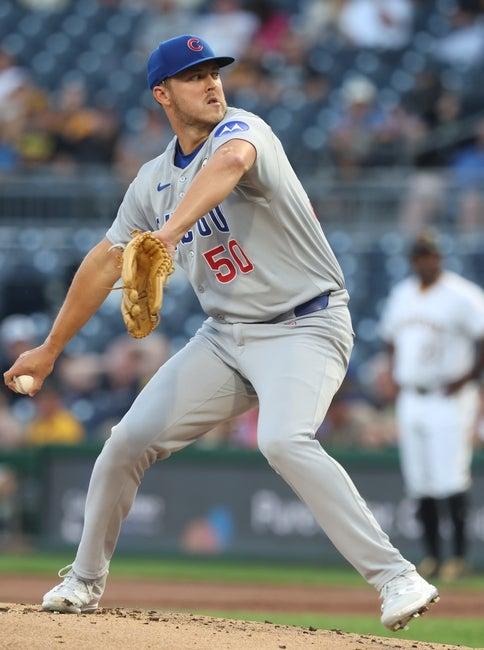
Two starters with WHIPs above 1.39 and ERAs that tell a damaging story take the mound at Kauffman Stadium — yet the total of 10.0 carries -114 juice on the under, treating this like a pitchers’ duel. Lynch’s ESPN ERA of 3.06 is a recent-window mirage; his full-season 5.03 and Taillon’s 6.16 alongside a forearm red flag point toward a very different run environment than that price implies.
Jameson Taillon vs Daniel Lynch IV: Toronto Blue Jays at Kansas City Royals Betting Preview
The total for this game sits at 10.0, and the casual reaction is to see a number that high and assume the market has done its homework. It hasn’t — or at least, it’s working with incomplete information on one of the two starters. Lynch’s surface-level ERA of 3.06 on ESPN’s feed is a recent-form mirage built on a small hot window. His full-season ERA is 5.03 with a WHIP of 1.42 across 154 innings. That’s not a quality pitcher — that’s a pitcher the market is underpricing as a run suppressor.
On the Toronto side, there’s no illusion. Taillon is listed on the 15-Day IL with a forearm issue and is making this start carrying a 6.16 ERA, a 1.39 WHIP, and 12 home runs allowed in just 57 innings. He’s pitching through a physical red flag against a Kansas City lineup that has genuine power from the first three spots. The setup for this game isn’t a pitchers’ duel — it’s two vulnerable arms facing lineups with real upside.
Toronto arrives having won five of six, most recently a 6-3 victory in Cleveland. Kansas City bounced back Thursday with a 7-3 win over Miami. Both teams enter with momentum, but tonight’s conversation begins and ends with what’s happening on the mound — and what’s happening on the mound is not pretty for either side.
Game Info & Betting Lines
- Date/Time: Friday, September 4, 2026 | 8:10 PM ET
- Venue: Kauffman Stadium | Park Factor: 0.95 (slightly pitcher-friendly)
- Probable Starters: Jameson Taillon (TOR) vs. Daniel Lynch IV (KC)
- Moneyline: Toronto Blue Jays +101 / Kansas City Royals -122
- Run Line: Kansas City Royals -1.5 (+158) / Toronto Blue Jays +1.5 (-193)
- Total: 10.0 (Over -105 / Under -114)
Why This Number Is Close — But Tilted in One Direction
The market set this total at 10.0 and put the juice on the under at -114. There’s a legitimate reason for that: Kauffman Stadium runs a park factor of 0.95, slightly suppressing scoring relative to league average, and the numbers project roughly 8.7-8.8 combined runs — a figure that falls meaningfully short of the posted total. The books aren’t wrong to shade toward the under.
But here’s where I think the market is slightly miscalibrated: it’s treating Lynch’s recent hot window as representative of his true ability, and it may be underweighting Taillon’s genuine physical vulnerability tonight. A pitcher returning from a forearm issue doesn’t typically rediscover clean mechanics in his first start back. His four-seam fastball sits at just 93.3 mph and generated a .345 xwOBA against this season — below-average stuff that Kansas City’s power hitters can damage.
The -114 juice on the under tells me the market has a mild lean that direction. But paying -114 to need two soft starters and two competent bullpen nights feels like asking for a lot. At -105 on the over, you’re getting a friendlier price on a bet that only requires one side to break open — and both pitchers have shown they’re capable of surrendering traffic in bunches. That asymmetry is where the value lives.
What Separates the Pitching
This isn’t a matchup where one arm clearly outclasses the other — it’s a matchup where both starters are genuinely soft, and the gap between them is about the type of damage they allow rather than who’s better.
Taillon’s biggest vulnerability is the home run. Twelve home runs in 57 innings is an extreme rate, and his arsenal doesn’t hide it. He leans on a four-seam fastball 47.9% of the time at 93.3 mph — a flat pitch that generates only a 15.3% whiff rate. Kansas City’s top of the order is built to punish exactly this profile. Jac Caglianone carries an xwOBA of .463 with a 34.8% hard-hit rate — he’s statistically one of the most dangerous contact producers in this matchup. Bobby Witt Jr. adds an xwOBA of .431 and a 31.6% hard-hit rate. Taillon’s curveball is his best swing-and-miss pitch at 31.3% whiff rate, but he throws it only 12.9% of the time — not enough to neutralize two elite Statcast profiles in the middle of the order.
Lynch, meanwhile, is leaking runs in a different way — volume and baserunners. His sinker (19.6% usage, .397 xwOBA against) and four-seamer (16.1% usage, .396 xwOBA against) are both premium contact pitches. His cutter at 89.9 mph generates a better 21.5% whiff rate, and his slow curve (only 2.5% usage) holds hitters to a .106 xwOBA — but he barely uses it. Tonight’s Toronto lineup gives Lynch real problems at the middle of the order. Vladimir Guerrero Jr. carries an xwOBA of .342 with a 30.3% hard-hit rate and a .372 xwOBA vs. left-handed pitching — Lynch throws a sinker and four-seamer that both grade out at nearly .400 xwOBA against, and Guerrero has the contact quality to exploit exactly that. Batting fifth, Sean Keys is the sleeper threat: a 35.8% hard-hit rate, an xwOBA of .328 overall, and a .538 xwOBA vs. left-handed pitching that jumps off the page. Both arms create innings that look like this: baserunners, extra-base contact, and bullpen calls earlier than managers want.
The Pushback
The honest concern here is that the numbers do not fully support this bet on their face. The projected combined total sits around 8.8 runs — more than a full run below the posted 10.0. Lynch has been pitching well in his recent window, and if that form holds for even five or six innings, the math gets harder. His slow curve generates a .106 xwOBA and a 33.3% whiff rate when he deploys it — if he starts leaning on that pitch more tonight, Toronto’s lineup could be in for a quieter night than the season numbers suggest. And Kauffman Stadium’s 0.95 park factor is a real suppressor, not a throwaway disclaimer.
I’m not dismissing that scenario. If Lynch pitches to his recent form and Taillon finds enough adrenaline to limit the damage for four or five innings, the under cashes easily. That’s the kill-ticket outcome, and it’s plausible.
What keeps me on the over despite the projection gap is the structural argument: two starters with elevated WHIPs (Taillon at 1.39, Lynch at 1.42) generate baserunner traffic even in their better outings. Baserunner traffic plus one bad inning from either arm — which both have demonstrated they’re capable of — gets this game to double digits without needing a blowout. At -105, I don’t need the blowup. I just need the traffic to convert once on each side.
Run Environment & Game Shape
Toronto’s team pitching ERA of 3.92 is respectable, but Taillon’s 6.16 ERA is a significant outlier dragging against that number tonight — the Blue Jays are not sending their rotation’s best. Kansas City’s team ERA of 4.71 reflects a staff that has been broadly hittable all season, and Lynch’s 5.03 true ERA fits that profile squarely. Neither bullpen offers a dramatic difference that would bail out the starters: both clubs carry mid-range relief corps without the elite depth needed to reliably slam the door after an early exit.
The game shape I expect is messy middle innings. Taillon gets through two or three innings on adrenaline, runs into Caglianone or Witt Jr. in a bad count, and the Royals break through. Lynch generates traffic against Guerrero Jr. and Keys, walks someone he shouldn’t, and the Blue Jays scratch across runs in a cluster. That’s the baserunner-traffic structural argument in real time — not a prediction of a shootout, but a prediction that two pitchers who routinely put men on base will eventually pay for it on the same night.
Kauffman’s 0.95 park factor is a headwind, not a wall. It shades this game toward caution on big numbers, which is reflected in the -114 under price. But the over is available at -105, and the 9-cent difference in juice matters when you’re building a case on two soft arms and elevated traffic risk. I’m not chasing a blowup — I’m betting that Taillon and Lynch each surrender one bad inning, and that’s enough.
Bet: Over 10.0 (-105) — 2 units