Elite pitching creates one equation — the total at 8 suggests another entirely. Two starters with sub-1.40 ERAs face lineups that haven’t cracked their code all season, but the market is pricing this around park factors instead of pitcher performance.
Trey Yesavage vs Cam Schlittler: Toronto Blue Jays at New York Yankees Betting Preview
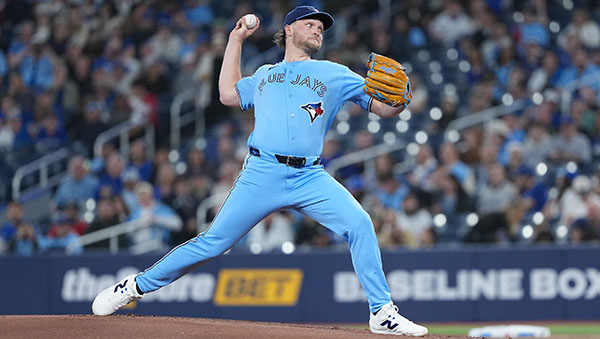
After watching these teams combine for 9 runs in each of their first two meetings, the market has settled on a total of 8 for tonight’s rubber match. That number feels about right for most pitching matchups at Yankee Stadium, but this isn’t most pitching matchups. Trey Yesavage has posted a 1.40 ERA through 19.1 innings while allowing zero home runs, and Cam Schlittler has been even better — a 1.35 ERA with a microscopic 0.78 WHIP across 60 innings of work.
The market is pricing this game around the ballpark factor and recent series scoring, but it’s not fully accounting for how these specific arms have neutralized good offenses all season. Both starters have shown they can handle elite lineups, and tonight’s environment favors exactly the type of game they create — low-contact, strikeout-heavy innings that minimize the big rallies this total needs to clear 8.
Game Info & Betting Lines
- Date/Time: Wednesday, May 20, 2026 | 7:05 PM ET
- Venue: Yankee Stadium (Park Factor: 1.05)
- Probable Starters: Trey Yesavage (TOR) vs Cam Schlittler (NYY)
- Moneyline: Toronto Blue Jays +150 / New York Yankees -178
- Run Line: New York Yankees -1.5 (+115) / Toronto Blue Jays +1.5 (-138)
- Total: 8 (O -110 / U -110)
Why This Number Is Close But Not Right
The total at 8 makes perfect sense if you’re looking at park factors, recent series results, and season-long offensive numbers. Yankee Stadium’s 1.05 park factor nudges run scoring higher, and both teams have shown they can put up crooked numbers — the Yankees averaging 5.08 runs per game, the Blue Jays at 4.12. The market has watched these teams score exactly 9 runs in consecutive games and reasonably expects something in that same range.
But that analysis misses the forest for the trees. Schlittler has been the best pitcher in baseball through two months, allowing just 2 home runs in 60 innings while maintaining elite command (11 walks, 68 strikeouts). Yesavage has been nearly as dominant in his smaller sample, posting zero home runs allowed and limiting hard contact with a devastating split-finger that’s generated a 42.6% whiff rate.
The concern is that both offenses have more upside than their recent cold stretches suggest, and we’re dealing with a small sample on Yesavage’s dominance. But when you have two starters performing at this level, the burden shifts to the hitters to prove they can break through — and neither lineup has shown that ability consistently in this series.
What Separates the Pitching
This isn’t about one starter dominating while the other struggles — it’s about two elite arms creating the same low-run environment from different angles. Schlittler’s four-seam fastball sits at 97.8 mph and generates a 34.3% whiff rate, working off a 94.1 mph cutter that holds hitters to a .250 xwOBA. His arsenal depth gives him multiple ways to attack any part of the lineup, and his 0.78 WHIP shows he’s not just missing bats — he’s avoiding hard contact entirely.
Yesavage works from a different angle but creates similar results. His split-finger at 81.9 mph has been unhittable, generating that 42.6% whiff rate while holding hitters to a .214 xwOBA. The pitch plays perfectly off his 93.9 mph four-seam, and hitters are struggling to time the speed differential. The zero home runs allowed isn’t luck — it’s the natural result of an arsenal that keeps hitters off balance and generates weak contact.
Where this matchup gets interesting is in the strike-throwing. Schlittler’s elite command (11 walks in 60 innings) means fewer free runners, while Yesavage has been slightly more hittable but devastating in put-away counts. Both pitchers limit the extended rallies that produce the crooked numbers this total needs, creating a game shaped more by solo shots and manufactured runs than the big innings both offenses are capable of.
The Pushback
The risk here is obvious — we’re betting against offense in a hitter-friendly park with two lineups that have shown explosive potential all season. The Yankees’ .766 OPS and 73 home runs through 49 games represent legitimate power, and Ben Rice has been particularly dangerous with a 1.068 OPS and 16 home runs. Aaron Judge carries a .975 OPS despite a slow start, and that’s the type of elite bat that can change a game with one swing.
The Blue Jays counter with Vladimir Guerrero Jr. showing signs of breaking out (.741 OPS) and Kazuma Okamoto providing consistent power (10 home runs). More concerning is Yesavage’s sample size — 19.1 innings is barely four starts, and even elite pitchers can get exposed when lineups see them for the second or third time.
But here’s what keeps me anchored to the under: both starters have faced quality lineups all season and continued to dominate. Schlittler’s 60-inning sample includes starts against tough offensive teams, and his metrics haven’t wavered. The recent series scoring that supports the total came against different pitchers — Dylan Cease and Patrick Corbin allowed most of those runs, not arms performing at this level.
Run Environment & Game Shape
The park factor at 1.05 suggests we should expect roughly half a run more than neutral, but that assumes average pitching. When you have starters performing at the level Schlittler and Yesavage have shown, park factors become less relevant — elite command and stuff travels to any ballpark. The expected game shape points toward a 4-3 or 5-3 type of contest, with one team scratching across an extra run late rather than the offensive explosion the over needs.
Both bullpens showed quality in yesterday’s game, with Yankees relievers Tim Hill, Jake Bird, and Brent Headrick combining for three scoreless innings. If the starters work deep — and both have the arsenal to do exactly that — we’re looking at limited bullpen exposure and fewer opportunities for the late-inning breakdowns that inflate totals.
Joe Jensen’s Pick
JENSEN’S PICK: Under 8 (-110) — 2 Units
I looked at the moneyline here, but Yankees ML at -178 exceeds my juice ceiling regardless of the pitching edge. The pick is Under 8 (-110), meaning the combined score must stay under 8. This number fails to account for just how dominant both starters have been, instead relying too heavily on park factors and recent series scoring against inferior pitching.
When you have two arms performing at a 1.35-1.40 ERA level with the arsenals to back it up, you’re betting on elite execution in a spot where the market expects average results. The sample size concern on Yesavage is real, but four starts of dominance against quality competition carries more weight than park factor adjustments.
I’m confident enough in this pitching gap to go two units, but not heavy enough for three — early-season variance is real, and one bad inning from either starter flips the entire game script. The edge is there, but it’s not a hammer-the-house situation in May.