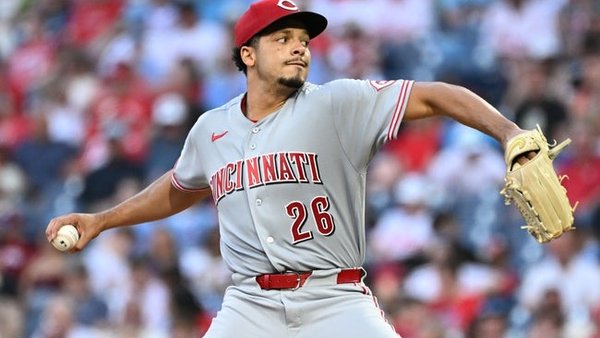
Chase Burns (2.61 ERA, 10.38 K/9) and Sandy Alcantara (3.52 ERA, 1.17 WHIP) are two of the more credible run-suppression arms on the slate — yet the total at Great American Ball Park is sitting at 8.0 with a park factor of 1.10 doing a lot of the pricing work. The mound profiles say the venue math is winning the argument it shouldn’t.
Sandy Alcantara vs Chase Burns: Miami Marlins at Cincinnati Reds Betting Preview
The market has set this total at 8.0, which on the surface feels reasonable for Great American Ball Park — a venue carrying a 1.10 park factor that tilts toward offense. But the number doesn’t fully account for what’s happening on the mound tonight. Chase Burns (13-2, 2.61 ERA, 10.38 K/9) is operating at an ace level that few starters in baseball are matching right now. Across from him is Sandy Alcantara (13-6, 3.52 ERA, 1.17 WHIP, 163.2 IP) — a workhorse who limits free passes and generates weak contact at a high clip. This isn’t a matchup where one team’s pitching propped up a weak lineup and inflated a W-L record. Both arms have earned their numbers.
The numbers project a combined 9.7 runs — which at first glance looks like it supports the over against a posted 8.0 total. But that framing gets it backwards. The 9.7 figure is itself inflated by GABP’s 1.10 park factor being baked into the run environment inputs. When you’re looking at two starters of this caliber — elite strikeout arms who routinely neutralize hitter-friendly dimensions — real run production should fall meaningfully below that park-adjusted projection, and likely below 8.0 as well. The engine may be overweighting venue without fully crediting how K-rate arms compress the run environment in practice.
The under at -117 is a manageable price for a game with this pitching ceiling. That’s the number I’m targeting tonight.
Game Info & Betting Lines
- Date/Time: Friday, August 14, 2026 | 6:10 PM ET
- Venue: Great American Ball Park (Park Factor: 1.10 — hitter-friendly)
- TV: MLB.TV, Reds.TV, Marlins.TV
- Probable Starters: Sandy Alcantara (MIA) vs Chase Burns (CIN)
- Moneyline: Miami Marlins +103 / Cincinnati Reds -111
- Run Line: Cincinnati Reds +1.5 (-205) / Miami Marlins -1.5 (+168)
- Total: 8.0 (Over -103 / Under -117)
Why This Number Is Close — But Beatable
The market isn’t wrong to set this at 8.0. GABP is legitimately hitter-friendly, and the Reds carry genuine pop in their lineup — Elly De La Cruz (20 HR), Sal Stewart (26 HR), and JJ Bleday (20 HR) can change a game in a single swing. Cincinnati’s pitching staff carries a 4.51 ERA and 1.410 WHIP team-wide, meaning if Burns exits early, the back end of this bullpen can leak runs. The 8.0 total is the market acknowledging all of that — it’s not an inflated number born from public bias.
But here’s where the market leans slightly wrong: it’s pricing in a park effect that elite strikeout arms routinely render irrelevant. Burns’ 10.38 K/9 limits baserunner accumulation so aggressively that GABP’s dimensions barely come into play — you can’t hit a ball out of the park if you’re not making contact. Alcantara’s sinker (26.1% usage, 97.2 mph, .293 xwOBA against) and changeup (20.0% usage, 26.4% whiff rate) generate the kind of weak contact that keeps rallies from compounding.
The under at -117 is pricing in some pitching quality, but not enough of it. Two starts of this caliber — both starters projecting to work 6-7 innings — make 8.0 a number the game should comfortably stay under.
What Separates the Pitching
Chase Burns is the clear headliner here, and the Statcast data backs it up. His fastball sits at 97.7 mph and accounts for 56.2% of his pitches, but it’s the slider that makes him elite: 38.0% usage, 90.2 mph, a staggering 49.7% whiff rate, and a .193 xwOBA against. That combination — heavy fastball usage at premium velocity paired with a swing-and-miss breaking ball that batters can’t square up — is why Burns leads this matchup. The Marlins’ lineup is built around contact hitters like Otto Lopez (.312 AVG, but a 3.8% barrel rate and .347 xwOBA) and Xavier Edwards (.282 AVG, 2.0% barrel rate, .320 xwOBA). Neither profile punishes Burns; his slider is precisely the weapon that neutralizes bat-to-ball hitters who lack the power to cover the outer third. The one genuine vulnerability worth flagging: Burns’ changeup carries a .428 xwOBA, and if the Marlins force him away from the fastball-slider combination, that pitch can be hit. It’s a real friction point on the under thesis, even if it’s only 5.3% of his usage.
Sandy Alcantara operates differently but effectively. He isn’t a swing-and-miss arm — his 7.04 K/9 trails Burns significantly — but his sinker-first approach (26.1% usage, 97.2 mph, .293 xwOBA against) induces soft contact and double-play opportunities. His cutter (.307 xwOBA, 20.9% whiff rate) and sweeper (.247 xwOBA, 28.1% whiff rate) provide secondary weapons against a Reds lineup that posts a .227 team batting average with 1,142 strikeouts on the season. Tyler Stephenson’s BvP history against Alcantara — .154 average with 8 strikeouts in just 14 PA — is a data point worth flagging, and Eugenio Suárez’s 36.0% strikeout rate and .111 average in 9 PA vs. Alcantara only reinforces the contact-suppression thesis.
The gap between the two arms is real but narrower than the ERA split suggests. Burns has more upside; Alcantara has more durability. Combined, they project to eat innings and keep run totals low through the sixth frame at minimum.
The Pushback
The concern I can’t dismiss is Great American Ball Park’s 1.10 park factor paired with the Reds’ genuine power ceiling. De La Cruz (8.5% barrel rate, .460 xwOBA), Stewart (7.0% barrel rate), and Bleday (5.4% barrel rate) all have the raw power to flip a low-scoring game in one at-bat. The Marlins’ bullpen is also worth watching: with Andrew Nardi (60-Day IL), Anthony Bender (15-Day IL), and William Kempner (15-Day IL) all unavailable, Miami’s relief depth behind Alcantara is genuinely depleted. If Alcantara exits before the seventh, the back end of that bullpen is an open question. And yes, the 13-1 blowout Miami absorbed Thursday at Pittsburgh is in the recent recaps — I’m stripping it of any predictive weight here. One complete-game shellacking against a different opponent in a different ballpark tells us nothing about tonight’s total.
I also looked at the Reds run line at -205 as a potential angle, given the pitching edges lean Cincinnati. But laying -205 on a projected margin of roughly 0.3 runs is simply too expensive for what the numbers actually support. The cleanest expression of this pitching thesis is the total, not the run line.
Run Environment & Game Shape
When you strip out the noise — the blowout, the park factor hype, the surface-level ERA comparisons — this game has a very specific shape. Two starters with legitimate run-suppression credentials, both expected to work deep into the game, facing lineups that profile as swing-and-miss heavy (Cincinnati’s 1,142 team strikeouts) or contact-dependent without elite power (Miami’s .730 OPS, 124 HR). The Marlins’ top-of-order xwOBAs against Burns — Marsee at .311, Edwards at .320, Lopez at .347 — are contact profiles, not damage profiles. The Reds’ middle of the order carries more pop against Alcantara, but Stephenson and Suárez’s BvP history against him (.154 and .111, respectively) suggests Alcantara has the sequencing to suppress even the legitimate threats.
The park factor is real, and I’m not dismissing it. But GABP’s 1.10 run factor is most dangerous when mediocre pitching allows the kind of baserunner accumulation that turns into multi-run innings. Against Burns’ 49.7% slider whiff rate and Alcantara’s sinker-induced soft contact, baserunner accumulation is precisely what doesn’t happen. The park factor in this specific pitching context actually amplifies the under edge rather than diminishing it — because the market is already pricing in a venue premium that these two arms have demonstrated, repeatedly, they can neutralize.
Both starters keeping this game in the 3-2 or 4-3 range through six or seven innings is the most likely path. That’s a total that lands comfortably under 8.0, and at -117, I’m getting a fair price on what the pitching matchup genuinely supports.
Bet: Under 8.0 (-117) — 2 units, moderate confidence.