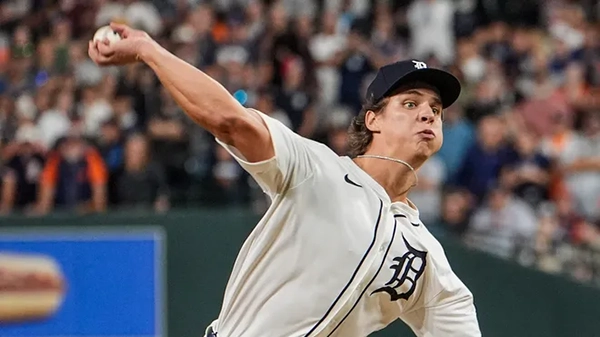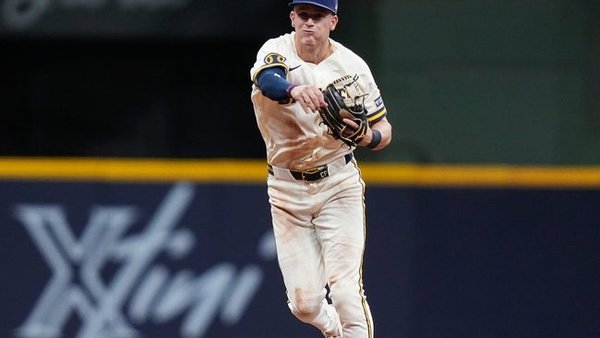
Chase Burns (2.36 ERA) and Jacob Misiorowski (1.45 ERA) are the two sharpest run-prevention profiles in the National League, and they are sharing the same dome on the same afternoon. The total is set at 6.5 with the under priced at even money — a coin-flip market framing that does not hold up against the combined strikeout and baserunner-suppression data these two starters have produced all season.
Chase Burns vs. Jacob Misiorowski: Cincinnati Reds at Milwaukee Brewers Betting Preview
The Brewers took yesterday’s series game 4-2, their sixth straight win over Cincinnati this season, and today the pitching matchup escalates significantly. When two legitimate ace-caliber starters share a mound in a neutral dome park, the market’s job is to price the run environment accordingly. At 6.5 with the under sitting at +100, it hasn’t done that job.
Jacob Misiorowski owns a 1.45 ERA and 0.77 WHIP across 99 innings — the best run-prevention profile in baseball in 2026. On the other side, Chase Burns has posted a 2.36 ERA and 1.08 WHIP with 112 strikeouts in 91.2 innings. This is not a case of one elite arm propping up an average opponent. These are two genuine top-of-rotation starters facing each other in a dome with a neutral park factor of 1.00.
The market is essentially calling this a coin flip between over and under. That framing makes sense if you’re projecting average pitching on both sides. It does not make sense when both starters rank among the top five ERA qualifiers in the National League. The under at even money is the play.
Game Info & Betting Lines
- Date/Time: Thursday, July 2, 2026 — 2:10 PM ET
- Venue: American Family Field (Dome — Park Factor 1.00, neutral run environment)
- Probable Starters: RHP Chase Burns (9-1, 2.36 ERA) vs. RHP Jacob Misiorowski (9-3, 1.45 ERA)
- Moneyline: Cincinnati Reds +164 / Milwaukee Brewers -196
- Run Line: Milwaukee Brewers -1.5 (+115) / Cincinnati Reds +1.5 (-138)
- Total: 6.5 (Over -122 / Under +100)
Why This Number Is Off
The legitimate case for the over — or at least for the line sitting at 6.5 — is that Milwaukee’s offense is genuinely dangerous. The Brewers average 5.17 runs per game on the season, sport a team OPS of .737, and have been punishing Cincinnati all series. Jackson Chourio (.883 OPS), Jake Bauers (.885 OPS), and Andrew Vaughn (.948 OPS) are legitimate threats against any starter. The market isn’t wrong to account for that firepower.
The flip side of that is what Burns actually does to good lineups. His 50.6% whiff rate on his slider at 90.6 mph is a genuine wipeout pitch — it generates an xwOBA of just .193 against. His four-seamer sits 97.9 mph and accounts for 56.2% of his pitches. Chourio is 0-for-3 with two strikeouts against Burns in limited BvP history — that’s a real signal even in a small sample. As for Bauers: in 2 PA against Burns, he has recorded a home run — the data shows a .1000 average display that’s almost certainly a formatting artifact of a 1-for-1 line, so I’m not treating it as a clean hit-plus-homer résumé. What I am treating it as is 2 PA. That’s noise, not a trend, and it’s not enough to overcome what Burns does to a lineup over a full start.
Where the market undershoots: 6.5 assumes roughly average starter quality on both sides. The combined projection of 8.1 runs uses baseline assumptions that these two arms should demolish. When you’re installing two pitchers with sub-2.40 ERAs into the same game, the historical run environment they create is structurally lower than what any projection built on league-average inputs will spit out. The +100 price reflects a coin-flip market. The pitching reality doesn’t.
What Separates the Pitching
The gap between these two starters and the rest of the field is the core of this bet, but Misiorowski and Burns are not equals — and understanding where one is sharper than the other matters for projecting game shape.
Misiorowski is operating at a different level right now. His 100.1 mph four-seamer — thrown 61.6% of the time — generates a 37.1% whiff rate with an xwOBA of just .235 against. That’s not a pitch hitters are squaring up; they’re fouling it off or missing entirely. Layer in a curveball with a 42.5% whiff rate and .192 xwOBA, and a cutter sitting at 95.9 mph, and you have an arsenal that punishes every quadrant of the zone. His 146 strikeouts in 99 innings (13.3 K/9) aren’t an accident — that’s an elite swing-and-miss profile at every count depth.
Cincinnati’s lineup amplifies Misiorowski’s edge. The Reds bat .228 as a team with a .698 OPS — among the weakest offensive profiles in the NL. Elly De La Cruz carries a season xwOBA of .480 and is legitimately dangerous in the aggregate, but his BvP against Misiorowski tells a different story: just 2 PA, 0-for-2, with a strikeout. His 28.7% season strikeout rate is a real exposure against triple-digit heat, and the limited head-to-head data doesn’t offer any counter-signal. Eugenio Suárez punches out at 33.5% with a modest 3.6% barrel rate — exactly the profile Misiorowski feasts on. And Cincinnati’s outfield situation is genuinely thin: both Dane Myers and Blake Dunn are on the IL (shoulder and elbow, respectively), with Matt McLain shifted to center field as a result — a position he’s played only a handful of times in his career. That’s a lineup already stretched now operating shorthanded in the outfield.
Burns is excellent, but the gap is measurable. His slider is arguably the better individual pitch — .193 xwOBA against at 90.6 mph with a 50.6% whiff rate is elite. But his four-seamer allows a .313 xwOBA at lower whiff rates (16.3%), and he’s surrendered 11 home runs compared to Misiorowski’s 5 in comparable innings. Burns profiles as a 6-7 inning, high-strikeout starter who keeps games tight. Misiorowski profiles as someone who doesn’t allow baserunners.
The type of innings each creates matters: Burns produces low-scoring, high-strikeout frames. Misiorowski produces clean innings with minimal traffic. Both outcomes point the same direction.
The Pushback
The honest friction here is the 8.1 combined run projection — that number is real, and it’s sitting 1.6 runs above the posted total. If I’m recommending the under at 6.5, I owe you a direct explanation of why I’m going against that figure rather than papering over it.
The 8.1 projection is a construction artifact. It’s built on component inputs — team offense, bullpen factors, park factors — that are calibrated against the full distribution of starting pitcher quality. When you feed in Milwaukee’s .737 OPS offense and Cincinnati’s .698 OPS offense and run them against league-average starter assumptions, you get a number that looks like 8.1. But Misiorowski and Burns aren’t league-average starters. They’re the two best ERA qualifiers in the NL right now, and the run environments they individually create are structurally below what baseline offensive inputs will generate against a replacement-level arm.
The Milwaukee offense that’s been shredding Cincinnati this series has done so against Shane Drohan, Brandon Sproat, and Robert Gasser. That’s three pitchers with ERAs ranging from league-average to below-average. The same lineup now faces Chase Burns and his 50.6% slider whiff rate. Those are different games. The 8.1 projection doesn’t make that distinction cleanly — I do.
The other legitimate pushback is Milwaukee’s bullpen erosion. DL Hall, Carlos Rodriguez, Rob Zastryzny, Angel Zerpa, and Brian Fitzpatrick are all on the IL. Aaron Ashby has been closing games and pitching in high-leverage spots all series. If Burns and Misiorowski both turn the game over by the seventh, the relievers who follow are operating at reduced depth — and that increases variance. It’s a real concern. It’s also not a reason to take the over when both starters are projected to dominate through six-plus innings and the game shape is inherently low-scoring.
Run Environment & Game Shape
American Family Field’s neutral park factor of 1.00 means the dome setting isn’t adding anything to the run environment here — no wind, no altitude, no quirk that inflates scoring. What you have is a controlled environment where pitcher quality is the dominant variable, and today that variable is skewed heavily toward suppression on both sides.
Game shape points to something in the 3-2 to 4-3 range. Misiorowski’s traffic-free innings profile and Burns’s strikeout-heavy approach both compress scoring opportunities. Cincinnati’s thinned lineup — already among the weakest in the NL offensively, now missing two center fielders with McLain pressed into an unfamiliar role — has limited margin for error against 100 mph heat. Milwaukee’s offense is real, but Chourio’s 0-for-3 with two punchouts against Burns is the kind of BvP data that matters when a wipeout slider is the primary weapon.
The under at +100 is one of the cleaner spots on the board today. You’re getting even money on a pitcher’s duel in a neutral dome, with two of the best starters in baseball and a posted total that hasn’t adjusted for the quality of arms involved. That’s the bet.
Bet: Under 6.5 — 3 units