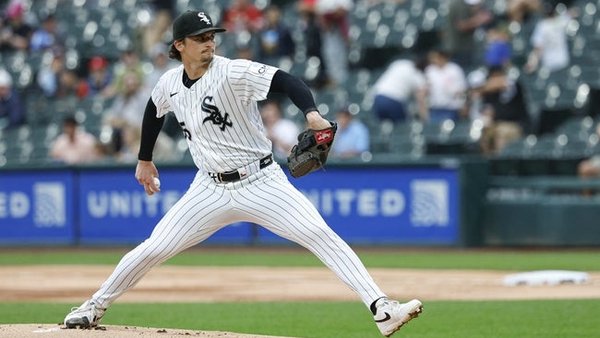
Davis Martin’s 2.78 BB/9 against Andrew Abbott’s 4.27 represents a structural pitching gap that the -129 moneyline hasn’t fully absorbed. Abbott’s 17 home runs allowed in 128.2 innings — nearly double Martin’s rate in comparable innings — points to a process problem that clean ERAs tend to obscure until a lineup like Chicago’s exposes it.
Andrew Abbott vs. Davis Martin: Cincinnati Reds at Chicago White Sox Betting Preview
The White Sox just rolled through the Reds 5-0 last night behind Luis Castillo’s 10-strikeout gem, and now Chicago turns to Davis Martin against Andrew Abbott in the series finale. The market has this priced as a mild lean toward the home side at -129, and that’s where the value lives. This isn’t a home-team bias play or a momentum chase — it’s a pitching matchup where one starter consistently suppresses free baserunners and home runs while the other has a walk and HR-allowed problem that real lineups exploit.
Abbott’s 3.92 ERA looks clean on the surface, and it’s earned him a reputation as a capable mid-rotation arm. But ERA doesn’t tell the whole story with a pitcher who has issued 61 walks in 128.2 innings and surrendered 17 home runs. Martin, by contrast, has walked just 38 batters in 123.0 innings with only 10 HR allowed — nearly half Abbott’s home run total in comparable work. That’s not noise. That’s a structural pitching gap the -129 price doesn’t fully account for.
Chicago is also simply the better team by every meaningful measure: a +41 run differential to Cincinnati’s -78, a 62-57 record versus the Reds’ 57-62, and a lineup that’s outscored Cincinnati by 79 runs on the season. At -129, this is fair value on the better team at home.
Game Info & Betting Lines
- Date/Time: Thursday, August 13, 2026 — 2:10 PM ET
- Venue: Guaranteed Rate Field (Park Factor: 0.98 — slightly pitcher-friendly)
- Probable Starters: Andrew Abbott (CIN) vs. Davis Martin (CHW)
- Moneyline: Cincinnati Reds +120 / Chicago White Sox -129
- Run Line: Chicago White Sox -1.5 (+153) / Cincinnati Reds +1.5 (-186)
- Total: 8.5 (Over -105 / Under -114)
Why This Number Is Close — But Slightly Off
The market is doing something reasonable here. Abbott’s 3.92 ERA is genuinely better than Martin’s 4.17, and that’s a legitimate reason to keep this price tight. The Reds also showed they can compete in this series — they rallied from three runs down to win game one 5-4, with Elly De La Cruz delivering the go-ahead sac fly in the 10th. Cincinnati is not a pushover, and the books are acknowledging that by keeping this well under -140.
But here’s where I think the market is slightly wrong: ERA comparison alone is a blunt instrument. When you dig into the underlying process, Martin’s profile is cleaner. His 1.33 WHIP versus Abbott’s 1.39 reflects more than a rounding error — it’s driven by a walk rate of 2.78 BB/9 compared to Abbott’s 4.27 BB/9. Fewer baserunners means fewer multi-run innings, and that matters in a game projected to be decided by roughly half a run.
The concern is that -129 is already pricing in some of Martin’s edge. The line isn’t dramatically mispriced — it’s slightly off, which is exactly where two-unit moderate plays live. This isn’t a hammer spot. It’s a spot where the data consistently points one direction at a number that remains clearable.
What Separates the Pitching
The gap between these two starters comes down to three things: walk rate, home run suppression, and arsenal quality under pressure.
Abbott leans heavily on his four-seam fastball at 45.7% usage — but it’s a 92.5 mph offering that hitters are posting a .403 xwOBA against with only an 11.1% whiff rate. That’s a below-average pitch by Statcast standards, and it’s the pitch he goes to nearly half the time. His saving grace is his sweeper (26.7% whiff, .235 xwOBA) and changeup (36.0% whiff, .279 xwOBA), which are genuine weapons — but when Abbott falls behind in counts with those 61 walks, he has to come back to a fastball hitters are sitting on. That’s how 17 home runs happen in 128.2 innings.
Martin operates with a different kind of profile. His four-seamer sits at 93.9 mph with a 20.4% whiff rate and .312 xwOBA — meaningfully better outcomes than Abbott’s primary pitch. More importantly, Martin’s curveball generates a 38.7% whiff rate and his slider adds another 37.3% whiff, giving him two put-away options that keep counts manageable. That’s what drives his superior K/9 of 7.9 against Abbott’s 6.92.
The mismatch becomes acute when you consider who’s hitting. Munetaka Murakami carries a .515 xwOBA with an 11.0% barrel rate and a 37.1% hard-hit rate — an elite contact quality profile by any measure. Abbott has allowed 17 home runs across 128.2 innings, a rate that reflects what happens when a walk-prone pitcher has to come back to a mediocre fastball against quality hitters. Murakami, sitting in the two-hole, is exactly that kind of hitter — he punishes count-leverage mistakes, and Abbott creates those mistakes at one of the higher rates in the league. On the other side, De La Cruz (.463 xwOBA) is dangerous against any starter, but Martin’s walk suppression limits the compounding damage that makes De La Cruz truly terrifying.
The Pushback
The honest case against this play starts with Abbott’s ERA. A 3.92 is not a fluke — it’s built across 128.2 innings, which is a legitimate sample. Abbott has been a streaky-but-capable arm, and his secondary offerings genuinely miss bats. The Reds also rallied late in game one of this series, which shows this lineup has fight in it when the moment calls for it.
The bullpen concern cuts both ways. Chicago is dealing with injuries to Jordan Leasure (60-day IL, forearm) and Chris Murphy (15-day IL, forearm), which thins out the late-inning options. But Cincinnati is also missing Graham Ashcraft (60-day IL, elbow) and Tony Santillan (15-day IL, oblique) from their relief corps — two arms who would typically factor into high-leverage situations. Neither pen is operating at full strength, which is part of why the numbers project a relatively high-scoring game. That symmetry doesn’t move the needle significantly on the starter-driven edge in Martin’s favor.
The run line is also a pass. Getting Chicago -1.5 at +153 is tempting when the numbers project a 4.8-4.3 final, but that half-run margin doesn’t give enough cushion to justify a spread where you need a multi-run win. The total at 8.5 is also a skip — the park factor at 0.98 nudges slightly pitcher-friendly, and while the projected total of 9.1 shows a modest over lean, it’s not enough separation from the 8.5 number to feel like a real edge after juice.
Run Environment & Game Shape
The numbers project a 4.8-4.3 final, which tells you this shapes up as a moderate-scoring game with legitimate contributions from both offenses. Neither team is projected to blow the other out — the White Sox scoring edge is real but not overwhelming, and that’s consistent with a park factor sitting right at 0.98. Guaranteed Rate Field is essentially neutral, so what you get here is a fairly clean read on the pitching and lineup matchups without a significant environmental thumb on the scale.
In games where both offenses are scoring at this clip, the starter who keeps the bases cleaner tends to dictate the shape of the game. Martin’s 2.78 BB/9 versus Abbott’s 4.27 BB/9 is the defining difference in that respect — fewer free passes mean fewer crooked-number innings, which means Chicago’s offense doesn’t need to do anything heroic to win. A 4-3 or 5-3 final is exactly the kind of game Martin’s profile sets up, and it’s the kind of game the White Sox moneyline at -129 is built to cash.
This game fits the profile of a moderate-confidence spot: the edge is real, the price is manageable, and the risk is contained. The pick is the Chicago White Sox moneyline at -129 for 2 units. Moderate confidence — the data points one direction, the number is clearable, and the better team is at home with the better starter.
Bet: Chicago White Sox ML -129 — 2 units (moderate confidence)