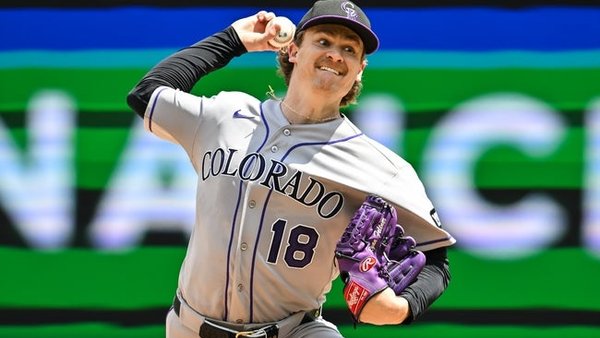
Kyle Leahy’s slider and curveball are generating combined whiff rates above 35% — yet the Cardinals’ own .694 team OPS raises a harder question about whether St. Louis can actually punish Ryan Feltner’s 5.75 ERA at the volume the price demands. The pitching gap is real; the offensive follow-through on both sides is where this number gets complicated.
Ryan Feltner vs Kyle Leahy: Colorado Rockies at St. Louis Cardinals Betting Preview
The market has priced St. Louis as a comfortable home favorite at -162, and the pitching gap absolutely justifies that directional read. Kyle Leahy (3.44 ERA, 1.33 WHIP, 107.1 IP) is a legitimate above-average starter, not just a serviceable arm holding a rotation slot. Opposite him, Ryan Feltner is posting a 5.75 ERA and 1.46 WHIP through 76.2 innings — genuinely bad numbers that track with someone who has been hit hard all season. The starter gap is real.
But the Cardinals’ own offense complicates the narrative. A team posting a .694 OPS and just 499 runs on the season is not a lineup that reliably piles on bad pitchers. They can beat Feltner, but they won’t necessarily bury him. That tension — strong pitching advantage, weak offensive follow-through on both sides — is what makes the Under 8.5 at +100 the cleanest expression of this game.
Busch Stadium carries a park factor of exactly 1.00 — no environmental inflation to worry about, no Coors Field asterisk distorting the numbers. What you see is what you get in a neutral run environment, and what you get here is a pitching-anchored game where the total ceiling is capped by both rosters’ offensive limitations.
Game Info & Betting Lines
- Date/Time: Friday, August 7, 2026 | 8:15 PM ET
- Venue: Busch Stadium | Park Factor: 1.00 (neutral)
- Probable Starters: Ryan Feltner (4-5, 5.75 ERA) vs. Kyle Leahy (7-4, 3.44 ERA)
- Moneyline: Colorado Rockies +136 / St. Louis Cardinals -162
- Run Line: St. Louis Cardinals -1.5 (+134) / Colorado Rockies +1.5 (-162)
- Total: 8.5 (Over -122 / Under +100)
Why This Number Is Close
The market set 8.5 as the total, and that’s not an unreasonable number. Feltner is capable of a short outing — his 17 home runs allowed in just 76.2 innings is an alarming rate, and if the Cardinals get to him early and often, a crooked number is possible. The over case is legitimate: you only need 9 combined runs with a pitcher like Feltner on the mound, and the Rockies have enough power (33 HR from Hunter Goodman, 19 HR from Mickey Moniak) to score even against quality pitching.
But here’s the problem with the over case: the Cardinals aren’t actually a team that exploits bad pitching efficiently. Their .694 OPS and 499 runs scored rank among the weaker offensive units in the National League. They grind. They don’t blow the doors off. Meanwhile, the Rockies are visiting Busch Stadium — away from Coors Field’s elevation and familiar dimensions, facing a starter who has been one of the better run-prevention arms in the NL this season.
The market is essentially splitting the difference between Feltner’s vulnerability and the Cardinals’ offensive limitations. Where I think the market is slightly wrong is underweighting how much Leahy’s consistent suppression profile anchors the total, particularly in a neutral park against a Colorado offense that has been ice-cold recently. The under at flat money is where the value lives.
What Separates the Pitching
The gap between these two starters is significant, and the Statcast data makes it concrete. Leahy’s best weapon is his slider, which generates a 36.5% whiff rate and holds hitters to a .261 xwOBA — an elite put-away pitch that he throws 24.1% of the time. His curveball is nearly as sharp: 35.3% whiff rate, .246 xwOBA. His 94.4 mph four-seam fastball (31.4% usage) sits a full three miles per hour harder than Feltner’s primary pitch, and the combination of velocity with two legitimate swing-and-miss offerings is what allows Leahy to work through lineups efficiently. Over 107.1 innings, that consistency is not a small sample — it’s a proven profile.
Feltner’s arsenal tells the opposite story. His four-seam fastball — his most-used pitch at 25.1% usage — generates only a 10.1% whiff rate and a punishing .405 xwOBA. That’s a below-average pitch getting punished when hitters make contact. His best offering is his knuckle curve (33.3% whiff, .332 xwOBA), but the problem is contact quality when hitters barrel his other pitches. Alec Burleson’s .430 xwOBA and 6.2% barrel rate make him a legitimate threat against right-handed pitching, and his .459 xwOBA versus right-handers specifically tells you the matchup is vulnerable.
The caveat here is that the Cardinals’ lineup around Burleson is thin. José Fermín posts a .296 xwOBA with a 1.3% barrel rate — essentially an automatic out in a power context. Nathan Church (.333 xwOBA) is serviceable but not dangerous. The Rockies face a dominant starter; the Cardinals face a bad one with a lineup that only partially has the teeth to capitalize. That partial cancellation is the core of the under thesis.
The Pushback
The honest concern here is Feltner’s home run rate. Seventeen home runs in 76.2 innings is not a rounding error — that’s a rate that can turn a 3-2 game into a 6-2 game with one swing. Jordan Walker (.834 OPS, 22 HR) is listed day-to-day with a knee injury, and his status is genuinely uncertain. If Walker plays and is healthy enough to drive the ball, he’s the Cardinals’ most dangerous hitter against a pitcher who gives up fly balls.
I’m not dismissing that risk — I’m pricing it in. The under at +100 gives you even money on a game where the starting pitching quality, the Cardinals’ .694 team OPS, and a neutral park factor all point toward a lower-scoring outcome. You don’t need a shutdown performance from Feltner. You just need the Cardinals to be the Cardinals offensively — a below-average run-producing unit that grinds out singles and doesn’t consistently punish bad pitchers the way the numbers say they should.
The Bet
Bet: Under 8.5 | +100 | 2 Units | Moderate Confidence
Leahy’s slider and curveball — combined whiff rates of 36.5% and 35.3% respectively — give him the swing-and-miss profile to keep Colorado’s lineup in check away from Coors. The Cardinals’ offense sits at a .694 OPS with 499 runs on the season, well below league average. Even with Feltner’s vulnerability (17 HR allowed in 76.2 IP), the Cardinals haven’t shown the offensive horsepower to bury bad pitchers at a consistent clip. Flat money on the under in a neutral park is the right play.