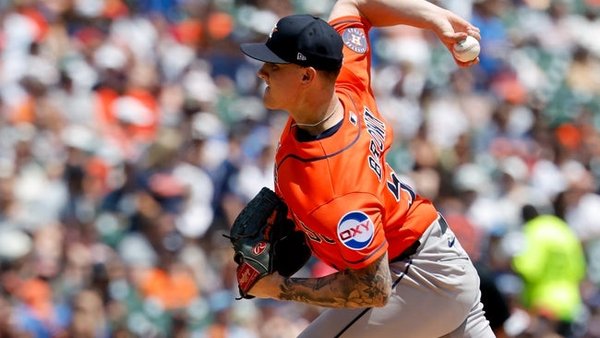
Hunter Brown’s surface ERA on the board is 3.52 — his actual number is 5.50, a gap wide enough to distort an entire run environment. The total of 8.0 is priced as though both starters are roughly equal, but Wacha’s contact-suppression profile and a dome playing at a 0.96 run factor tell a different story than the posted number.
Michael Wacha vs Hunter Brown: Kansas City Royals at Houston Astros Betting Preview
The posted total of 8.0 for Tuesday’s game at Daikin Park looks reasonable at first glance — two below-average offenses, a pitcher-friendly dome, and a reasonable pair of starters on paper. But the paper version of this game and the real version diverge sharply the moment you look past the ESPN lines. Michael Wacha is carrying a 3.52 ERA and 1.10 WHIP on the season — his ESPN-listed ERA of 3.25 is close enough to reality to be trusted. He’s a contact-management arm who doesn’t blow hitters away but limits crooked innings. Hunter Brown, by contrast, is carrying a 5.50 ERA and a 1.46 WHIP through 55.2 innings — numbers that reflect a pitcher who walks too many, allows too much hard contact, and gives up home runs at a rate (9 allowed) that outpaces his workload. ESPN has him at 3.52. That gap isn’t a rounding error; it’s a market inefficiency.
The case for the under isn’t that both starters are dominant. It’s that Wacha genuinely suppresses runs, that Brown’s strikeout rate (8.89 K/9) gives him a mechanism to strand baserunners and avoid the multi-run inning, and that neither offense can be trusted to generate sustained production. Daikin Park plays at a 0.96 run factor — historically a mild suppressor. The numbers project 8.8 combined runs, only 0.8 above the posted total. Against a pitcher-friendly environment and two mediocre lineups, that narrow margin tilts toward the under at -115.
Game Info & Betting Lines
- Date/Time: Tuesday, September 15, 2026 | 8:10 PM ET
- Venue: Daikin Park (Minute Maid Park) — Dome | Park Factor: 0.96 (slight run suppressor)
- Probable Starters: Michael Wacha (KC) vs Hunter Brown (HOU)
- Moneyline: Kansas City Royals +138 / Houston Astros -168
- Run Line: Houston Astros -1.5 (+130) / Kansas City Royals +1.5 (-158)
- Total: 8.0 (Over -105 / Under -115)
Why This Number Is Close
The market has set 8.0 with clear logic: Houston’s offense is built around power (197 team home runs, Yordan Alvarez posting a 1.016 OPS and 38 home runs), and Brown — however volatile — has the strikeout profile to generate swings and misses. The over side points to Brown’s instability as a path to a high-scoring first few innings if Kansas City strings together walks and contact early.
That’s a legitimate read. Brown’s 1.46 WHIP means he puts runners on at an uncomfortable rate, and Kansas City’s top of the order has some teeth — Bobby Witt Jr. sits at an .808 OPS with a .433 xwOBA, and Jac Caglianone carries a .460 xwOBA with genuine power potential. These are not empty lineup spots.
But here’s the problem: Kansas City has scored 1 run in each of their last two games against Boston, and their season OPS of .715 ranks in the bottom third of the league. The market is priced for a version of KC’s offense that hasn’t shown up recently. Wacha, meanwhile, limits hard contact efficiently — his slider generates a .225 xwOBA against with a 35.1% whiff rate, and his changeup sits at .311 xwOBA. Houston’s lineup isn’t going to hammer a contact-management arm all night. Nick Allen leads off at a .274 xwOBA overall and just .257 against right-handers. Jose Altuve posts a .288 xwOBA against righties. Batting second, Nelson Velázquez is the real threat in this order — a .495 xwOBA overall and a dangerous .544 xwOBA against right-handed pitching. He’s the hitter most capable of punishing Wacha’s sinker-heavy approach, and he can’t be papered over. The market has priced a moderate run environment. I think it’s slightly above where this game actually lands — but Velázquez is the honest reason this isn’t a comfortable under.
What Separates the Pitching
The pitching gap here isn’t as wide as Brown’s ERA suggests, but it’s real in a specific way. Wacha works with four pitches in a controlled, contact-management pattern. His sinker (30.0% usage, 94.1 mph) generates 14.3% whiff and a .337 xwOBA — not a swing-and-miss pitch, but one that produces weak ground contact. His changeup (24.5% usage, 85.7 mph) and slider (19.9% usage, 87.2 mph, .225 xwOBA) are the weapons that actually suppress hard contact. The Houston lineup facing Wacha looks shaky in the Statcast splits: Altuve at .288 xwOBA against right-handers, Paredes at .298 against righties, Allen at .257 — three of the top five spots in the order are below-average matchups for a right-handed contact-suppressor. Velázquez at .544 is the clear exception, and his presence batting second means Wacha has to navigate danger early every single inning.
Brown is a different animal. His four-seam fastball accounts for 47.0% of his pitches at 93.0 mph, generating 24.5% whiff — genuinely above average — but surrendering a .403 xwOBA against, which is where the damage accumulates. His sweeper (25.2% usage, 80.8 mph) is his best secondary weapon: 39.7% whiff rate and a .195 xwOBA against make it a legitimate out pitch. The changeup (17.0% usage, 31.8% whiff, .269 xwOBA) also plays. Brown’s problem is not that he lacks weapons — it’s that when he misses with the fastball, he gets punished, and with a 1.46 WHIP, he misses too often.
The gap that matters for the total is this: Wacha keeps innings clean more consistently; Brown creates higher-variance innings that can go either way. Brown’s 8.89 K/9 is the safety valve — he can punch out Witt or Jensen when he needs to strand a runner. But the floor of his performance is meaningfully lower than Wacha’s, and in a pitcher-friendly dome against a cold KC offense, that variance is the primary risk to the under rather than a reason to fade it.
The Pushback
The honest version of the case against this play starts with Brown’s actual numbers. A 5.50 ERA and 1.46 WHIP don’t produce reliable unders — they produce blowup innings. The over case here is essentially a bet that Brown gives up a crooked number early, Kansas City’s lineup gets going off a leaky fastball, and Houston’s bullpen has to cover early damage. That scenario is entirely plausible given what Brown has actually done this season.
Then there’s Alvarez. A .515 xwOBA, 38 home runs, a 1.016 OPS — Wacha’s sinker-heavy approach can generate weak contact against most of this lineup, but Alvarez is not most of this lineup. His barrel rate (8.3%) and hard-hit rate (30.6%) suggest he can punish the sinker if it catches too much plate. Wacha’s slider (.225 xwOBA against) is the pitch that neutralizes right-handed power hitters, but Alvarez is a left-handed hitter — the slider matchup is less automatic than it would be against a righty. And as noted above, Velázquez in the 2-hole compounds the threat: his .544 xwOBA vs. right-handers makes him arguably the single most dangerous matchup-specific hitter in this order, even more than Alvarez in terms of platoon advantage against Wacha specifically.
The bullpen concern is real on both sides. Kansas City’s relief corps is thinned by injuries — Carlos Estevez (shoulder), Nick Mears (shoulder), Connor Seabold (lat), and Beck Way (shoulder) are all unavailable. Houston’s relievers have been leaned on heavily after being swept by Tampa Bay, with Bryan Abreu already deployed in the ninth inning of a blowup. Bullpen volatility cuts both ways, but it does mean neither team is walking into this game with a pristine backend.
Run Environment & Game Shape
Daikin Park’s 0.96 run factor is real but modest — this isn’t a pitcher’s park so much as a neutral-to-slight suppressor. The dome element matters more for consistency: no wind, no rain, no weather variable. What you get is a controlled environment where the pitching matchup and lineup quality dominate the outcome. In this case, that means Wacha’s contact-suppression profile has a clean surface to work on, and Brown’s fastball-heavy approach faces a KC lineup that’s been scoring one run a game.
The risk sits in the 9-10 run range if Brown loses the fastball command early and Velázquez or Alvarez does damage before he can reach his sweeper. That’s the over scenario. But the base case — Wacha pitches five or six innings of three-run ball, Brown manages to strand enough baserunners with his 8.89 K/9, and neither bullpen implodes — lands comfortably under 8. Two cold offenses, one genuinely run-suppressing starter, and a dome that erases weather variance. That’s enough to take the under at -115 for 2 units.
Bet: Under 8.0 (-115) — 2 Units — Moderate Confidence. Brown’s real ERA is the inefficiency, Wacha’s run suppression is the floor, and the dome keeps the environment clean. Velázquez and Alvarez are the live threats that keep this moderate rather than strong.