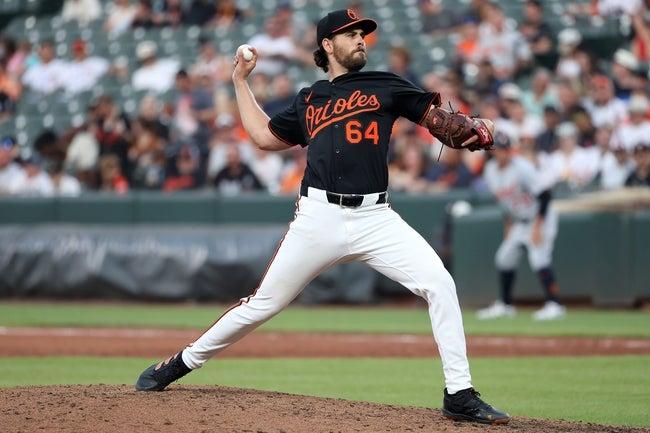
Comerica Park runs at a neutral 0.99 park factor, yet the total of 8.0 is anchoring too heavily on Anderson’s quality-start profile while underweighting what Kremer’s 5.81 ERA and 15 home runs in 66.2 innings projects against a Detroit middle order built to punish right-handed contact. The number feels half a step behind the pitching split.
Dean Kremer vs. Drew Anderson: Minnesota Twins at Detroit Tigers Betting Preview
Detroit took Game 1 of this series in a back-and-forth 5-4 finish, and now the pitching matchup shifts considerably. The Tigers send out Drew Anderson (3.73 ERA, 91.2 IP), while the Twins counter with Dean Kremer (5.81 ERA, 66.2 IP) — a gap that should be pricing the total higher than 8.0. The moneyline at -143 is getting all the attention, but that price exceeds my juice ceiling, and the run line doesn’t have sufficient margin support. The cleaner expression of this lean is the Over 8.0. A combined projected total of 9.1 runs represents a 1.1-run mispricing in a neutral park, and it’s the angle worth addressing tonight.
The market is balancing Anderson’s quality start profile against a Tigers offense that is working through its own cold stretch. Both pitching staffs carry injury wear this deep into September, and the total reflects a relatively contained game. But Kremer’s profile — 5.81 ERA, 15 home runs allowed in just 66.2 innings — creates a real ceiling on how much the Twins can keep Detroit’s lineup quiet. The over is not a slam dunk here, but the pricing feels half a step behind the pitching split.
Game Info & Betting Lines
- Date/Time: Tuesday, September 8, 2026 | 6:40 PM ET
- Venue: Comerica Park | Park Factor: 0.99 (essentially neutral)
- Probable Starters: Dean Kremer (MIN, 2-5, 5.81 ERA) vs. Drew Anderson (DET, 4-5, 3.73 ERA)
- Moneyline: Minnesota Twins +119 / Detroit Tigers -143
- Run Line: Detroit Tigers -1.5 (+144) / Minnesota Twins +1.5 (-175)
- Total: 8.0 (Over -119 / Under -101)
Why This Number Is Off
The market setting 8.0 here isn’t irrational — Comerica Park runs at a 0.99 park factor, essentially neutral, and Anderson has been one of the better mid-rotation arms in the AL this second half. A total in the low eights for a neutral-park game with a credible home starter makes structural sense. The under at -101 is also unusually cheap, signaling the books aren’t deeply committed to the low-scoring scenario either.
But here’s the problem: the line appears to be anchoring too heavily on Anderson’s side of the equation without fully pricing in how exposed Kremer has been. At a 5.81 ERA across 66.2 innings, Kremer is surrendering runs at a clip that projects to at least 4-5 Detroit runs before the bullpen takes over. Meanwhile, Minnesota’s staff ERA of 4.66 versus Detroit’s 3.68 confirms this isn’t a symmetric matchup from a run-prevention standpoint — one team has a significantly deeper pitching structure than the other.
The market is set where it is because Anderson could keep this game tight on his end and Kremer could piece together five workable innings. That scenario exists. But when you run the numbers — 9.1 combined — and the over is sitting at -119, you’re getting a price that hasn’t fully moved to reflect the pitching gap on the visiting side.
What Separates the Pitching
The gap between these two starters is substantial, and it runs across every meaningful metric. Anderson brings a 95.5 mph four-seam fastball that he deploys 39.8% of the time, generating an xwOBA-against of .315 and an 18.3% whiff rate on that pitch alone. His changeup — thrown 30.5% of the time at 90.0 mph — is the real weapon, holding hitters to a .281 xwOBA with a 34.7% whiff rate. His curveball rounds out the arsenal at 23.0% usage with a 32.6% whiff rate and .263 xwOBA. This is a three-pitch starter who can generate swings and misses at multiple points in the count. His 9.92 K/9 and 13 home runs allowed in 91.2 innings reflect a pitcher who controls the zone without leaving the ball over the plate.
Kremer profiles very differently. His four-seam sits at 92.9 mph and carries a .393 xwOBA against — hitters are squaring it up. His sinker is the most vulnerable pitch in the arsenal at .468 xwOBA. While his splitter (38.0% whiff rate, .240 xwOBA) and cutter (.288 xwOBA) can miss bats, the overall package surrenders hard contact at a rate Anderson does not. Fifteen home runs in 66.2 innings tells the contact quality story.
The Detroit lineup compounds the exposure. Riley Greene carries a .470 xwOBA and a .496 xwOBA against right-handed pitching specifically — Kremer is right-handed. Eduardo Valencia is at .438 xwOBA overall and went 4-for-5 with a home run in his limited sample against Kremer (5 PA, .800 average, 1 HR). Dillon Dingler has a .426 xwOBA versus right-handers. The middle of Detroit’s order is built to hurt the exact type of pitcher Kremer is.
The Pushback
The concern is real: both offenses have been cold. Detroit has been running below its season average in recent games, and Minnesota’s offense has been underperforming its 4.65 runs-per-game season baseline during a recent cold stretch. If both lineups continue to underperform — a real possibility deep in September when lineup construction has injury gaps on both sides — the over can stay under 8 without anyone breaking a sweat.