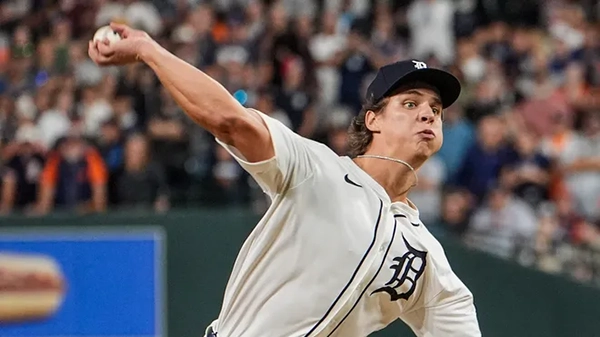
A 4.77-run ERA gap separates today’s starters, yet the total sits at 9 — a number the market has already shaded down from last night’s homer-fest without fully accounting for Schlittler’s elite suppression profile. Mikolas’ 20 home runs surrendered in 90.1 innings keeps the over alive, but the asymmetry between these two arms points sharply in one direction.
Cam Schlittler vs Miles Mikolas: Yankees at Nationals — Under 9 Breakdown
After the Yankees’ 5-3 win last night — a game that featured six home runs between two clubs that rank 1-2 in the majors in long balls — the series shifts to a drastically different pitching environment. The market has noticed: the total sits at 9, down from the run-happy atmosphere of last night’s opener. But the real story isn’t yesterday’s result. It’s the 4.77-run pitching gap between today’s two starters, and whether Cam Schlittler’s elite profile can suppress enough offense to make the under viable even against a Washington lineup that isn’t going to be intimidated by anyone.
The Yankees’ moneyline at -190 is simply unplayable — it blows past any reasonable juice ceiling regardless of how dominant Schlittler looks on paper. But the pitching edge he provides doesn’t disappear because the ML is overpriced. It shows up elsewhere. The cleanest market expression of Schlittler’s dominance is the total, where the numbers project a combined 9.1 runs — essentially sitting dead on the number, with the under holding implied value if he delivers anything close to a quality start.
Mikolas is the wild card that makes this uncomfortable. His 5.78 ERA in 90.1 innings is a genuine liability, and the Nationals’ bullpen has its own injury concerns. This isn’t a lock — it’s a lean, and the distinction matters when you’re betting into a total that’s already priced for a pitcher-friendly game.
Game Info & Betting Lines
- Date/Time: Saturday, July 11, 2026 — 4:05 PM ET
- Venue: Nationals Park (Park Factor: 0.98 — marginally pitcher-friendly)
- TV: MLB.TV, Nationals.TV, YES
- Probable Starters: Cam Schlittler (NYY, 9-5, 2.01 ERA) vs. Miles Mikolas (WSH, 3-7, 5.78 ERA)
- Moneyline: Yankees -190 / Nationals +160
- Run Line: Yankees -1.5 (-113) / Nationals +1.5 (-106)
- Total: 9 (Over -110 / Under -110)
Why This Number Is Close
The market has done its homework. A total of 9 reflects two things simultaneously: Schlittler is elite and the park plays slightly below average for run scoring, but Washington’s lineup is legitimately dangerous and Mikolas is a known crooked-inning risk. The bookmakers aren’t giving this game away — they’re pricing in the tension between a shutdown arm on one side and a volatile one on the other.
The legitimate case for the over starts and ends with Mikolas. His 20 home runs allowed in 90.1 innings is a catastrophic rate, and last night proved this series is living and dying by the long ball. The Yankees have the power to exploit him — Ben Rice hit his 29th last night, Jasson Domínguez went deep, Austin Wells added one. If Mikolas surrenders three home runs in five innings, you’re already at 3-4 runs off his hand alone before Schlittler’s side is even factored in.
But here’s where the market may be slightly wrong: it’s treating Mikolas’ blow-up risk as roughly equivalent to Schlittler’s suppression ability, when the asymmetry runs entirely in one direction. The numbers project New York at 4.9 and Washington at 4.2 — a combined 9.1 that barely clears the posted 9. Any Schlittler quality start that keeps the Yankees in the 4-5 run range makes the under work even if Mikolas gives up 4. The under doesn’t need both pitchers to succeed. It only needs Schlittler to do his job.
What Separates the Pitching
The gap between these two arms is not subtle. Cam Schlittler carries a 2.01 ERA and 0.9285 WHIP over 112 innings — a full-season sample that eliminates small-sample noise. His four-seam fastball sits at 97.8 mph and generates a 29.4% whiff rate with an xwOBA-against of just .240. He throws it 44.2% of the time, pairing it with a 94.5 mph cutter (27.0% usage, 19.0% whiff) and a 97.6 mph sinker that generates grounders at a .254 xwOBA. His curveball — used only 7.3% of the time — whiffs hitters at a 35.8% clip. This is not a pitcher who misses in one phase; he misses across his entire arsenal.
Crucially, Schlittler’s command profile makes him a route-to-deep-innings pitcher. Just 21 walks in 112 IP (1.69 BB/9) means he’s rarely manufacturing his own trouble. He accumulates outs efficiently, which limits the Nationals’ ability to string together the kind of multi-hit sequences that produce crooked numbers. James Wood’s xwOBA of .586 with an 11.4% barrel rate makes him the most dangerous individual matchup against Schlittler — that 36.1% hard-hit rate is real — but even Wood has struck out twice in just three plate appearances against him (limited BvP sample).
Miles Mikolas is operating in a different universe. His 93.2 mph four-seamer generates a 12.1% whiff rate and an alarming .369 xwOBA-against. His sinker is worse — 6.5% whiff, .349 xwOBA. His sweeper, used 6.1% of the time, carries a .404 xwOBA-against. The lone pitch in his arsenal that grades as functional is his slider — a .267 xwOBA at 21.9% usage — but even that offering doesn’t generate misses (16.8% whiff, 12.5% put-away). He’s inducing contact rather than swing-and-miss even with his best pitch, which tells you exactly why the home run rate is so high. When you can’t put hitters away, the balls that do get hit hard end up in the seats. His 4.98 K/9 is the natural result of an arsenal built on contact management, and that approach has failed spectacularly — 20 home runs surrendered in 90.1 innings is not a blip, it’s a feature of how he operates.
The Pushback
I’m not going to pretend the Mikolas risk doesn’t exist — because one Mikolas blow-up inning makes you sweat from the second frame. Washington’s lineup is real. Luis Garcia Jr. carries an .894 OPS with his 11th home run in 18 games since June 19. CJ Abrams has 20 on the season. James Wood is a barrel threat every time up. If the Yankees put up a crooked number early and Mikolas follows by surrendering three solo shots in the fourth, you’ve got a game that cracks double digits regardless of what Schlittler does on his side.
The Nationals’ bullpen situation adds another layer. With Mitchell Parker (60-Day IL), Richard Lovelady (15-Day IL), and Brad Lord (15-Day IL) all unavailable, Washington’s relief options are stretched thin. If Mikolas exits early, the back end of that bullpen is not a comfort. A long, ugly middle-inning stretch can inflate a total in a hurry even when the starting pitcher on one side is holding his end of the bargain.
That’s the honest version of the over case, and I think bettors should sit with it before putting money on the under. This isn’t a spot where the over is irrational — there’s a real path to 10+ runs if Mikolas gets shelled early and the Yankees start piling on.
The Under Thesis
And yet, I still come back to Schlittler. The under thesis is clean precisely because it doesn’t require Mikolas to be good — it only requires Schlittler to be what he’s been all season. A 2.01 ERA over 112 innings isn’t a hot streak; it’s a sustained body of work from a pitcher with genuine miss-bat stuff across four pitches, elite command, and the stamina to go deep into games. If Schlittler posts six innings of two-run ball — which is well within his established floor — the under is alive regardless of what Mikolas does on the other side. Even a four-run Mikolas line only gets you to 6, and Schlittler limiting Washington to two or three puts this game well short of 9.
The Mikolas blow-up risk is real, and I won’t pretend otherwise — a short, ugly outing from him is the primary way this bet loses. But the line at 9 is already pricing in some of that risk, and Schlittler’s upside is severe enough to carry the position even if the Washington side of the ledger gets messy. The line hasn’t moved far enough to account for what a legitimate ace-level start from Schlittler does to a combined total.
Bet: Under 9 — 2 units, moderate confidence.